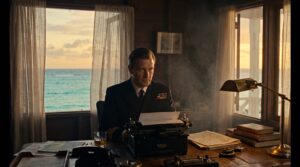
A cinematic tribute to the world of secret agents, exploring the legacy, evolution, and timeless appeal of James Bond through decades of spy storytelling.
Introduction
If you are looking for a complete guide to every james bond actor in order, you have come to the right place. For over six decades, the cinematic incarnation of James Bond has served as an ultimate anchor point for global pop culture. Ian Fleming’s sophisticated, ruthless MI6 agent evolved from a mid-century literary creation into the longest-running continually active film franchise in history. As political climates changed, technology leaped forward, and visual storytelling evolved, the mantle of 007 shifted across generations.
Every time a new actor steps into the tailored tuxedo, they don’t just speak iconic lines—they redefine masculinity, action choreography, and contemporary style for their respective eras. Tracking these james bond actors in order provides a fascinating roadmap through film history.
📌 Read Also: The 15 Most Iconic Bond Girls Who Redefined the 007 Franchise
The Complete Chronological Timeline of 007
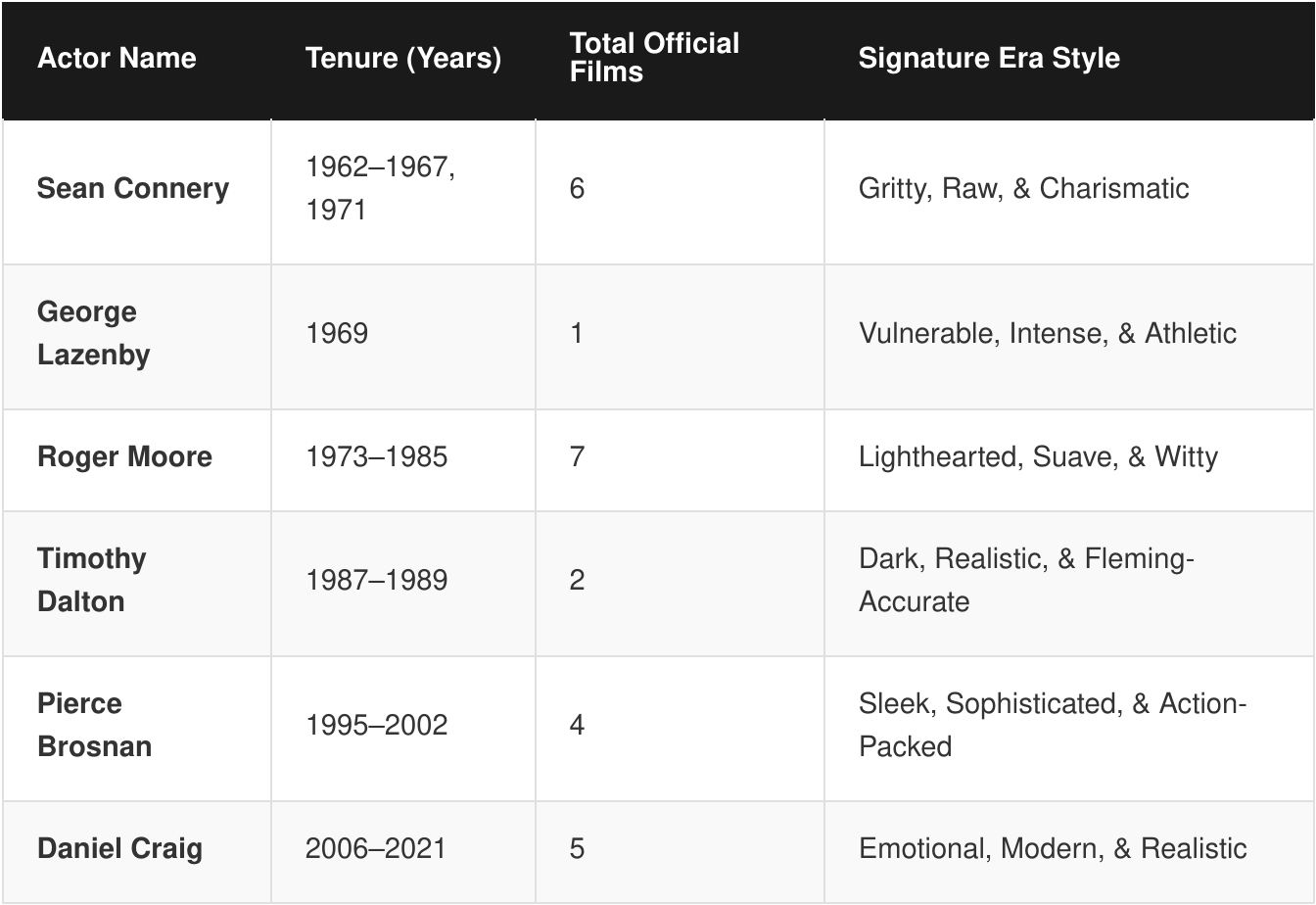
The evolution of James Bond spans across distinct eras, highlighted by shifting thematic overtones and diverse box-office heights. Below is the historical sequence of the official Eon Productions eras.
- 1962–1967: The Sean Connery Era — Establishes the cinematic identity of Bond with classics like Dr. No, From Russia with Love, and Goldfinger.
- 1969: The George Lazenby Interlude — A single-film tenure for On Her Majesty’s Secret Service, offering a more vulnerable, romantic take on the agent.
- 1971: The Connery Return — Connery steps back into the role one final time for Eon Productions in Diamonds Are Forever.
- 1973–1985: The Roger Moore Era — The longest-serving Bond by film count, emphasizing tongue-in-cheek humor, global adventures, and high-tech gadgets.
- 1987–1989: The Timothy Dalton Era — A dark, gritty, and fiercely literary reconstruction that closely mirrored Ian Fleming’s darker source novels.
- 1995–2002: The Pierce Brosnan Era — A sleek, blockbuster-focused revitalization that bridged classic smooth-talking charm with late-90s action aesthetics.
- 2006–2021: The Daniel Craig Era — A complete narrative reboot focusing on continuity, psychological trauma, raw physical vulnerability, and serialization.
The Official James Bond Actors in Order
1. Sean Connery: The Original Blueprint (1962–1967, 1971)
When Scottish actor Sean Connery first uttered the words “Bond. James Bond” in 1962’s Dr. No, cinema history changed forever. Casting director choices originally leaned toward classical English archetypes, but producers Albert “Cubby” Broccoli and Harry Saltzman opted for Connery’s raw, magnetic masculinity.
Connery imbued Bond with a dangerous, panther-like grace that balanced high-society refinement with working-class grit. His run featured the structural genesis of the series: the signature theme music, the introduction of Q-branch gadgets, eccentric megalomaniacs, and breathtaking locations. After growing fatigued by the intense media circus surrounding the franchise, he stepped away after You Only Live Twice (1967), only to return for a lucrative, final Eon appearance in Diamonds Are Forever (1971).
- Official Eon Films: Dr. No (1962), From Russia with Love (1963), Goldfinger (1964), Thunderball (1965), You Only Live Twice (1967), Diamonds Are Forever (1971).
2. George Lazenby: The Lone Rebel (1969)
Faced with the monumental task of replacing Connery, producers selected Australian model and novice actor George Lazenby for 1969’s On Her Majesty’s Secret Service. Lazenby brought immense physical prowess to the role, performing many of his own complex stunts.
While his performance drew criticism at the time for lacking Connery’s effortless theatricality, his single film has undergone a major critical reappraisal in recent decades. Featuring an emotional narrative arc where Bond falls in love and marries Tracy di Vicenzo (Diana Rigg), Lazenby’s era showed a deeply humanized version of the spy. Advised by his agent that the hippie movement would make a clean-cut secret agent obsolete in the 1970s, Lazenby famously declined further contract offers after just one film.
- Official Eon Films: On Her Majesty’s Secret Service (1969).
3. Roger Moore: The Suave Showman (1973–1985)
Needing a stable presence to guide the franchise through changing cinematic landscapes, Eon turned to established television star Roger Moore. Already famous for The Saint, Moore made the active decision not to mimic Sean Connery. Instead, he injected the character with sophisticated humor, self-deprecating wit, and a famously raised eyebrow.
Moore’s tenure leaned heavily into the camp and spectacle of the late 1970s and early 1980s, matching contemporary trends by taking Bond to outer space in Moonraker (1979) and into structural pop-art extravaganzas. Holding the record for the most official Eon appearances at seven films, Moore brought an enduring, lighthearted charm that kept the franchise incredibly lucrative during turbulent financial decades.
- Official Eon Films: Live and Let Die (1973), The Man with the Golden Gun (1974), The Spy Who Loved Me (1977), Moonraker (1979), For Your Eyes Only (1981), Octopussy (1983), A View to a Kill (1985).

4. Timothy Dalton: The Living Weapon (1987–1989)
As the mid-80s demanded grittier action heroes, Welsh Shakespearean actor Timothy Dalton took the reins. Dalton was determined to scrub away the whimsical, comedic elements of the Moore years, returning directly to Ian Fleming’s original novels.
Dalton’s Bond was serious, intensely focused, and visually plagued by the moral ambiguities of his job. Licence to Kill (1989) showcased a rogue agent driven by personal revenge, pushing the franchise into much darker territory. Though his run was cut short by lengthy legal battles over studio distribution rights, Dalton’s realistic, harder-edged interpretation laid the literal foundation for what the character would become in the 21st century.
- Official Eon Films: The Living Daylights (1987), Licence to Kill (1989).
5. Pierce Brosnan: The Post-Cold War Icon (1995–2002)
After a six-year hiatus, Pierce Brosnan stepped into the frame for 1995’s GoldenEye. Brosnan represented a perfect synthesis of his predecessors: he possessed the lethal coolness of Connery, the effortless elegance of Moore, and the underlying dramatic intensity of Dalton.
Brosnan navigated a post-Cold War world where MI6’s relevance was openly questioned by a new female M (Judi Dench). His films seamlessly merged classic espionage tropes with modern, explosive Hollywood blockbuster scale. Brosnan successfully introduced 007 to a generation of fans raised on video games (specifically the iconic GoldenEye 007 on Nintendo 64), proving that the character could thrive long after the fall of the Berlin Wall.
- Official Eon Films: GoldenEye (1995), Tomorrow Never Dies (1997), The World Is Not Enough (1999), Die Another Day (2002).
6. Daniel Craig: The Modern Realist (2006–2021)
When Daniel Craig was announced as the sixth Bond in 2005, initial internet backlash was vocal regarding his blond hair and rugged appearance. However, 2006’s Casino Royale instantly silenced detractors. Craig delivered a visceral, bruised, and emotionally raw version of Bond, depicting his very first mission as a 00 agent.
Craig’s era broke franchise tradition by utilizing a continuous, serialized narrative arc that tracked the emotional consequences of Bond’s violent lifestyle. His run culminated in No Time to Die (2021), providing a definitive, tragic closing chapter to a highly successful era that brought unmatched depth, artistic prestige, and billions in box-office revenue to the series.
- Official Eon Films: Casino Royale (2006), Quantum of Solace (2008), Skyfall (2012), Spectre (2015), No Time to Die (2021).
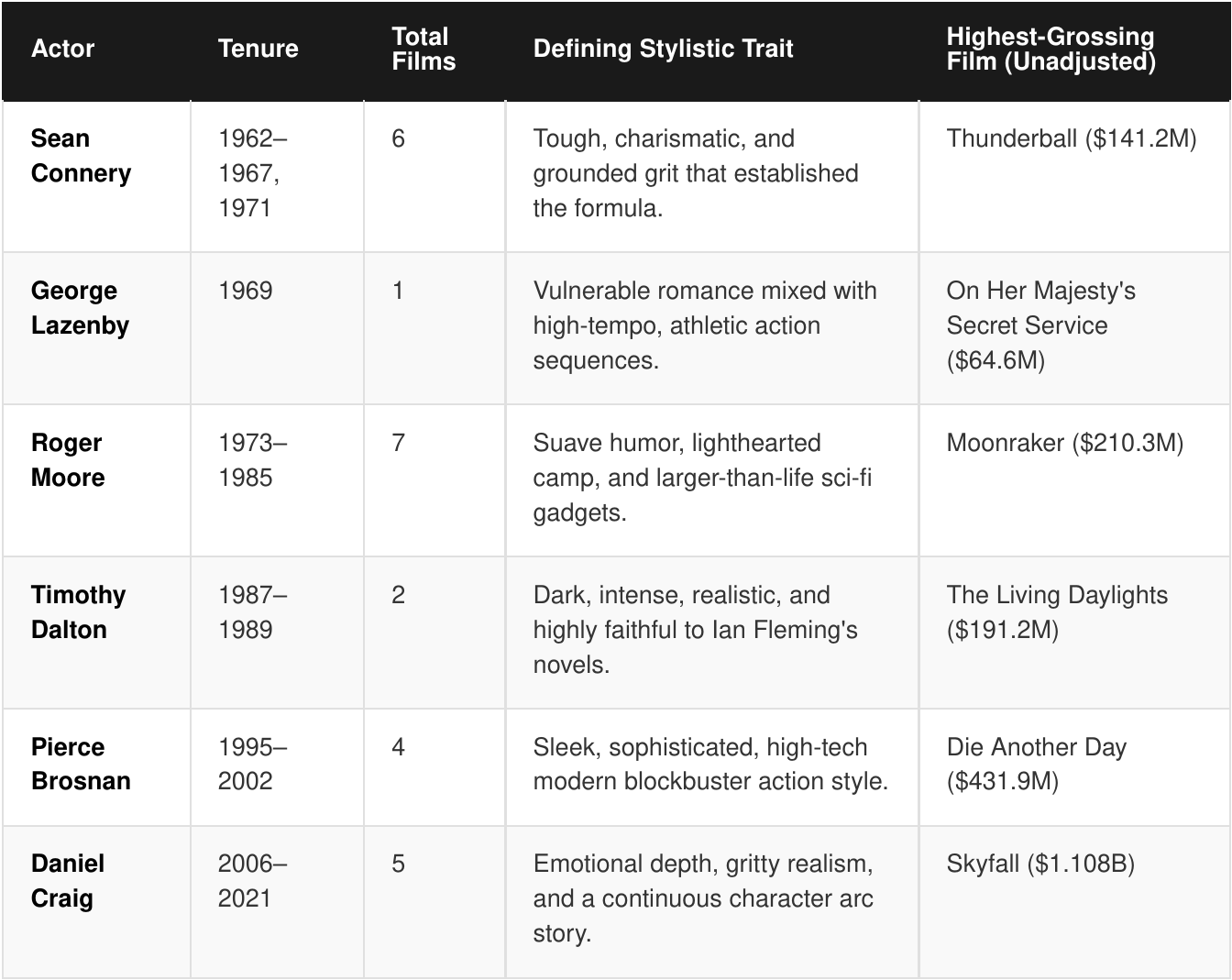
Comparison of the Official Bond Eras
To understand how each actor shaped the landscape of the franchise, we can evaluate their film counts, box office highlights, and stylistic footprints side by side.
The Unofficial Bonds: Alternative Realities
While the Eon Productions lineage is considered the definitive canon, two other notable film portrayals exist outside of this sequence:
- Barry Nelson (1954): The very first live-action portrayal of James Bond occurred on American television in an episode of the anthology series Climax! adapting Casino Royale. Nelson played an Americanized version of the character referred to as “Jimmy Bond”.
- David Niven (1967): A satirical, non-Eon production of Casino Royale starred David Niven as an elderly, retired version of Sir James Bond. The film was a chaotic spoof of the exploding spy genre.
- Sean Connery (1983 – Never Say Never Again): Produced by an independent studio due to a complex legal loophole regarding the film rights to Thunderball, Connery returned to play an aging Bond in direct theatrical competition with Roger Moore’s official Eon film Octopussy.
Casting the Future: The Post-Craig Era

Following the definitive conclusion of Daniel Craig’s narrative arc in No Time to Die, the question of who will inherit the license to kill remains one of Hollywood’s biggest open mysteries. Behind the scenes, Amazon MGM Studios and Eon long-time producers Barbara Broccoli and Michael G. Wilson are carefully engineering the next cinematic reset.
Industry reports indicate that filmmaker choices are narrowing down alongside script work from seasoned writers. Longtime casting directors are searching for a fresh face—likely a British actor in his late twenties or early thirties—who can commit to a rigorous 10-to-15-year multi-film trajectory. While names like Aaron Taylor-Johnson and Callum Turner frequently populate prediction markets and rumor mills, history shows that the franchise frequently favors an enigmatic talent poised on the brink of superstardom over an established A-list celebrity.
Interesting Facts About the James Bond Actors
- The Age Gap: Roger Moore was actually three years older than Sean Connery, making him the oldest actor to debut as Bond (at age 45 in Live and Let Die) and the oldest to retire from the role (at age 57 in A View to a Kill).
- A Royal Honor: Three James Bond actors have been officially knighted by the British monarchy for their immense contributions to film and drama: Sir Sean Connery, Sir Roger Moore, and Daniel Craig, who was appointed a Companion of the Order of St Michael and St George (CMG)—the exact honor held by the fictional James Bond.
- The Accent Spectrum: Despite playing the ultimate British intelligence officer, the six official actors represent an incredibly diverse array of nationalities: Sean Connery (Scottish), George Lazenby (Australian), Roger Moore (English), Timothy Dalton (Welsh), Pierce Brosnan (Irish), and Daniel Craig (English).
FAQs
Who played James Bond the longest?
In terms of chronological years holding the official role, Daniel Craig holds the record, spanning 15 years between Casino Royale (2006) and No Time to Die (2021). In terms of total individual film count, Roger Moore leads the official Eon franchise with 7 movies.
Why did Timothy Dalton only make two Bond movies?
Timothy Dalton was fully prepared to film a third James Bond movie in the early 1990s. However, intense legal disputes between the production company, Eon, and the distributor, MGM, indefinitely delayed the franchise for six years. By the time the legal issues resolved, Dalton’s contract had expired, and he chose to step down, clearing the path for Pierce Brosnan.
Is the next James Bond actor officially confirmed?
No official cinematic successor to Daniel Craig has been definitively announced by Eon Productions or Amazon MGM Studios. The search is actively underway, focusing on finding a young performer capable of anchoring a completely fresh narrative direction for the franchise.
Conclusion
The enduring legacy of James Bond lies in its unique capacity for reinvention. From the mid-century coolness of Sean Connery to the uncompromising grit of Daniel Craig, each actor left an indelible fingerprint on the character’s DNA. As film fans await the next transformation of MI6’s top agent, the existing 25-film canon stands as an extraordinary monument to cinematic storytelling. The tuxedo remains waiting, ready to transform yet another actor into a timeless icon.