
Short Answer
The Casino Royale ending explained in one line: Bond wins the $115 million poker game with a straight flush, survives Le Chiffre’s torture, and falls in love with Vesper Lynd — only to learn she betrayed him, then watch her drown in a sinking Venetian palazzo. Bond traces the stolen money to Mr. White, shoots him in the leg, and introduces himself with the line that makes him Bond: “The name’s Bond, James Bond.” The ending works because it is a love story that ends in betrayal, and the betrayal is what turns a blunt new agent into 007.
More people search for the Casino Royale ending explained than for any other Bond finale except Skyfall. That is not an accident. Casino Royale (2006), directed by Martin Campbell and starring Daniel Craig in his first outing as 007, is the only Bond film that ends with its hero losing the woman he loves, quitting the service, and then walking straight back into it — all in the space of twenty minutes.
If you watched it once and felt the last act moved too fast, you are not alone. The film packs a poker showdown, a kidnapping, a torture scene, a resignation, a betrayal, a drowning, and a cold-blooded revenge into its final stretch. This is the Casino Royale ending explained, step by step, with every question the finale raises answered in plain language.
The Story So Far: What You Need Before the Final Act
To make sense of the Casino Royale ending, you need three facts from the first two acts. First, Le Chiffre, played by Mads Mikkelsen, is a banker to terrorists. He lost his clients’ money on a failed stock market bet after Bond foiled a bombing at Miami airport, and the only way to pay them back is to win it back at a high-stakes poker tournament at the Casino Royale in Montenegro.
Second, Bond has been staked $10 million by MI6 to play in that tournament, with Vesper Lynd, played by Eva Green, holding the purse strings as the Treasury’s representative. His mission is simple: bankrupt Le Chiffre at the table so that his own clients kill him.
Third, Bond and Vesper, who start the film sniping at each other across a train compartment, have slowly become something more — and that is the real story the ending is about.

That setup is the whole engine of the story, and it is why a Casino Royale ending explained in full has to start with the poker table, not the twist. The poker game is not a set piece; it is the mission. Bond loses his first buy-in to Le Chiffre and has to be staked back into the game by CIA agent Felix Leiter, played by Jeffrey Wright. He wins the tournament in the final hand. And then, in the space of one evening, everything the mission was supposed to achieve falls apart — because the woman Bond trusts most has already sold him out.
The Ending in 60 Seconds: A Timeline of the Final Act
The Casino Royale ending explained as a timeline makes the last act far easier to follow:
- The final hand: Four players go all-in on a $115 million pot. Fukutu shows an ace-high flush, Infante shows a full house, eights full of aces, and Le Chiffre shows a higher full house, aces full of sixes. Bond turns over the five and seven of spades, completing a straight flush, four through eight of spades, and wins the tournament. It is the most improbable hand in the series, and the film knows it — the room erupts because nobody at the table saw it coming.
- The kidnapping: Minutes after the game, Vesper is taken outside the casino. Bond gives chase in his Aston Martin, which flips end over end when he swerves to avoid her body lying in the road. He wakes up a prisoner.
- The torture: Le Chiffre tortures Bond in a bare room, demanding the password to the account holding the tournament winnings. Bond refuses, even as the beating goes on. Then Mr. White, played by Jesper Christensen, walks in and shoots Le Chiffre dead. Le Chiffre has become a liability to his own organisation, and White removes him. Bond and Vesper are left alive.
- The recovery: Bond wakes in hospital and recovers at a villa on Lake Como. He resigns from MI6, ready to leave the spy world behind for Vesper. The two of them travel to Venice, enjoying a brief, quiet happiness that the film lets you believe in — which is exactly why what comes next hurts.
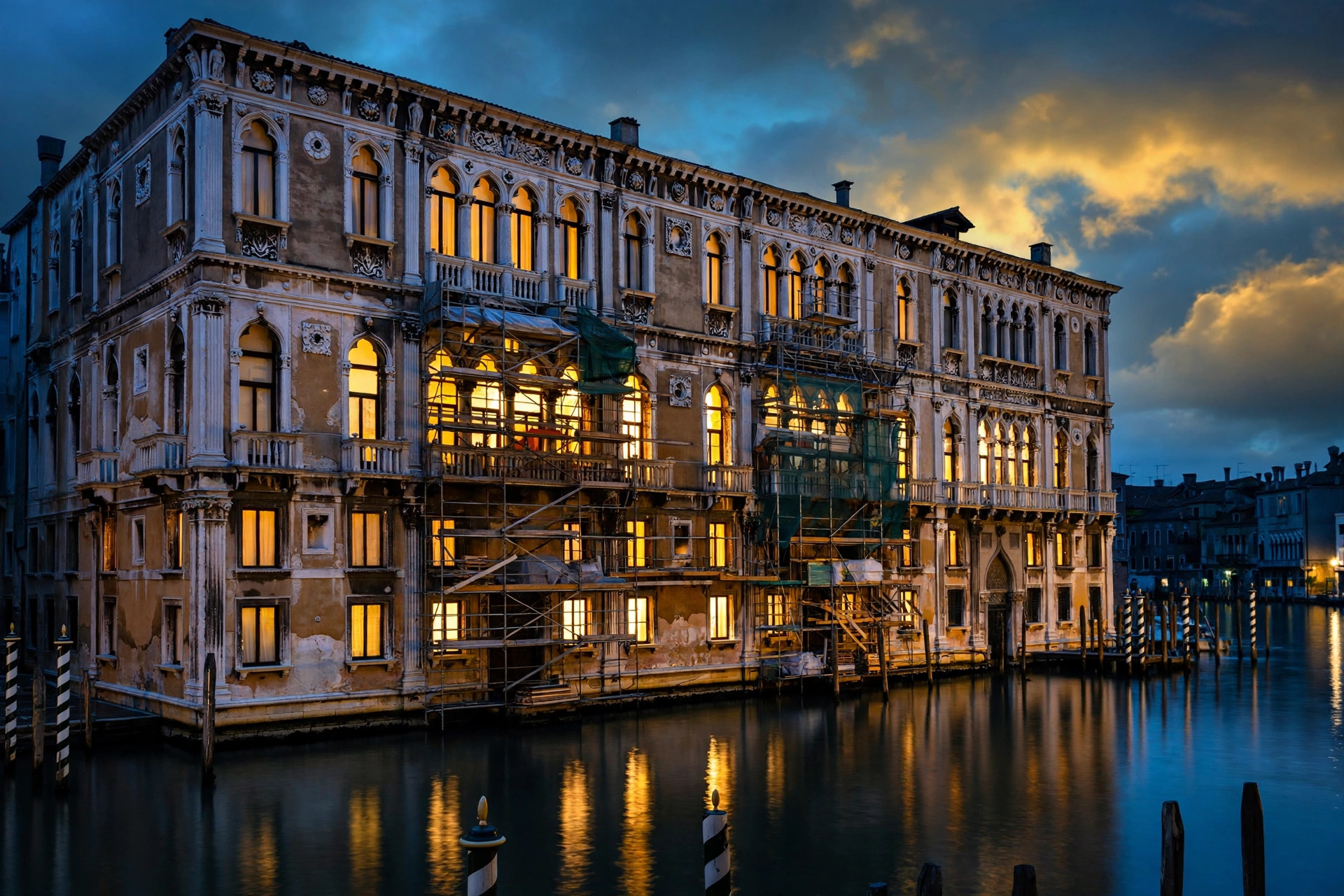
- Venice: Vesper spots a man with an eye patch, Gettler, an agent of White’s organisation. Bond realises the tournament winnings never reached the Treasury. He follows Vesper to a palazzo under renovation on the Grand Canal, where she is handing the money over. Bond shoots the building’s flotation supports, the palazzo sinks into the canal, and Vesper, trapped in a sinking elevator cage, locks herself inside and drowns rather than face him or her captors.
- The phone call: M, played by Judi Dench, tells Bond the truth. Vesper had a boyfriend who was kidnapped, and the organisation blackmailed her into stealing the money. She made a deal: the winnings in exchange for Bond’s life. Bond’s reply is the coldest line in the franchise: “The bitch is dead.”
- The coda: Bond finds Mr. White’s number on Vesper’s phone and tracks him to a villa on Lake Como. White steps out of his car, answers his ringing phone, and Bond shoots him in the leg. As White crawls up the stone steps, Bond steps into view and delivers the line the whole film has been holding back: “The name’s Bond, James Bond.”
Why Vesper Betrays Bond
The most common question in any Casino Royale ending explained discussion is whether Vesper was ever on Bond’s side at all. The answer is yes — and that is what makes the betrayal tragic rather than cynical. Vesper was not a villain. She was a Treasury official who fell in love with the man she was sent to watch, and she was blackmailed before the film even began. Her boyfriend had been kidnapped by the organisation behind Le Chiffre, and the price of his life was the tournament money. She played her part, kept Bond alive where she could, and made one final deal: the winnings in exchange for Bond’s life.
That deal is the key to the whole Casino Royale ending explained in this article. When M explains it to Bond, the film reframes everything you just watched. Vesper did not betray Bond for money or for the other side. She betrayed him to save him, and she knew the price. The sequel, Quantum of Solace (2008), later names the man who seduced her as Yusef Kabira, a member of the same organisation who made a career of compromising women in exactly this way. Vesper was his victim before she was ever Bond’s betrayer, and the film wants you to understand that before you judge her.
It also matters, for any Casino Royale ending explained fairly, that Vesper’s love for Bond was real. The film shows it in small, unguarded moments: the way she stays at his hospital bedside, the way she laughs with him on the train, the way she looks at him on the beach at Lake Como. She was not acting. She was a woman caught between two impossible loyalties, and she chose Bond’s life over her own freedom. When she locks herself in the sinking elevator, it is not a villain’s exit. It is a woman who believes she has destroyed the one good thing in her life and cannot face what comes next.
The Venice Sinking, Step by Step
The Venice sequence is the emotional centre of the Casino Royale ending explained here, and it works because the film has spent two hours earning your trust in this couple. Here is how it unfolds. Bond and Vesper are happy, or as happy as Bond ever gets. Then Vesper sees Gettler, the man with the eye patch, across a crowded square. Her face changes. Bond, who has learned to read people for a living, sees it instantly. He checks the Treasury account and finds the money is gone. The betrayal is not revealed in a speech; it is revealed in a bank balance.
Bond follows her to a palazzo under renovation on the Grand Canal, where the money is changing hands. He storms in, and in the fight that follows he shoots the building’s flotation supports. The palazzo begins to sink. Vesper is trapped in an iron elevator cage as the water rises. Bond fights through debris and floodwater to reach her, and for a moment it looks like he will. Then she does the thing nobody expects: she locks the cage door from the inside. She chooses to drown rather than be rescued into a life where she has to explain what she did.
Bond pulls her lifeless body from the water and tries to revive her. He cannot. The scene is shot without music swelling to tell you how to feel, and it does not need it. Vesper’s death is the moment Daniel Craig’s Bond becomes Bond — the moment he learns that love, for a man in his line of work, is a vulnerability his enemies will always exploit. Everything that follows in the Craig films, from his coldness in Quantum of Solace to his grief in Skyfall, starts here, in a sinking building in Venice.
Film vs Novel: How the Ending Changes
Casino Royale is based on Ian Fleming’s first Bond novel, published in 1953, and the film keeps the bones of Fleming’s ending while changing the details. Here is the Casino Royale ending explained as a comparison:
| Element | Fleming’s novel (1953) | The film (2006) |
|---|---|---|
| The game | Baccarat, at a French casino | Texas Hold’em poker, in Montenegro |
| Vesper’s death | Suicide by an overdose of sleeping pills in her hotel room | Drowning in a sinking elevator in a Venetian palazzo |
| The blackmailers | SMERSH, the Soviet counter-intelligence agency | An unnamed criminal organisation, later revealed as Quantum in the sequel |
| Her lover | A Polish RAF pilot, kidnapped and tortured by SMERSH | An unnamed boyfriend, later named as Yusef Kabira in Quantum of Solace |
| The final line | “The bitch is dead” — Bond’s cold report to his service | Spoken aloud to M on the phone, then followed by the Lake Como coda |
| Mr. White | Does not exist in the novel | Invented for the film; kills Le Chiffre and becomes the thread into the next three films |
The biggest change is the coda. Fleming’s novel ends on that bleak line, with Bond shutting off his feelings. The film adds the Lake Como scene because a reboot needs a beginning as well as an ending. Bond does not just lose Vesper; he finds the man behind her betrayal, and in confronting him he finally becomes the character the audience came to see.
The Final Scene: Mr. White and the Line
The last two minutes of Casino Royale are the most quoted in the franchise, and no Casino Royale ending explained is complete without them. Bond finds Mr. White’s number on Vesper’s phone and tracks him to Villa La Gaeta, a villa on the western shore of Lake Como. White drives through the gate in his Jaguar, steps out, and answers his ringing phone. Bond, hidden nearby, shoots him in the leg. White crawls toward the stone steps, and Bond steps into frame, standing over him with a gun, and says it for the first time in the film: “The name’s Bond, James Bond.”

The line lands because the film has withheld it for two and a half hours. Every previous Bond film opens with it, or close to it. Casino Royale refuses. Craig’s Bond earns his 00 status in the opening scene, loses his money, loses his love, and only then, standing over the man who destroyed both, becomes the character. It is also a promise: White does not die. He survives, badly hurt, and returns in Quantum of Solace and Spectre, which means this ending is not a full stop. It is the first chapter of a story that runs through all five Craig films.
One detail worth knowing: the recovery scenes earlier in the film were shot at a different Lake Como villa, the Villa del Balbianello in Lenno, where Bond convalesces after Le Chiffre’s torture. The film uses two villas on the same lake for two very different moments — one for healing, one for revenge — and the contrast is deliberate. Bond arrives at Lake Como broken and leaves it as 007.
5 Questions the Ending Leaves Behind
- Did Vesper really love Bond? Yes — and any Casino Royale ending explained honestly starts with that answer. The film shows it in her hospital vigil, her laughter on the train, and her final deal — she traded the money for Bond’s life, not for her own freedom. Her betrayal was coerced, and her love was the one thing her blackmailers could not fake.
- Could Bond have saved Vesper in Venice? He tried. He fought through a collapsing building and floodwater to reach her elevator cage. But Vesper locked the door herself, and by the time Bond pulled her from the water it was too late. The film frames her death as her choice, not his failure — which is why Bond’s grief turns to coldness rather than guilt.
- Who is Mr. White? A high-ranking member of the criminal organisation behind Le Chiffre. He kills Le Chiffre for becoming a liability, spares Bond because a dead agent is no use to him, and takes the money Vesper stole. He returns in Quantum of Solace and Spectre, where his story finally ends.
- Why does Bond say “The bitch is dead”? It is the film’s coldest line, taken almost word for word from Fleming’s novel, where it is Bond’s report to his service. In the film, Bond says it to M on the phone after learning the truth about Vesper. It is not cruelty for its own sake; it is Bond shutting a door. The man who loved Vesper is gone, and the agent is all that is left.
- Does the ending connect to the next film? Yes, directly. Quantum of Solace (2008) picks up minutes later, with Bond driving away from Lake Como with a prisoner in his boot. The organisation behind Vesper’s blackmail becomes the main villain of the sequel, and Vesper’s name haunts Bond through all five Craig films.
Our Take
The Casino Royale ending works because it is the only Bond finale that dares to be a tragedy. Most Bond films end with a quip, a kiss, and a speedboat. Casino Royale ends with a drowning, a cold phone call, and a man shooting another man in the leg on a quiet lakeside terrace. That bleakness is earned: the film spends two hours showing you why Vesper matters to Bond, then takes her away in front of him, and it refuses to soften the blow with a twist or a rescue.
It is also the smartest ending of the Craig era, and the reason a Casino Royale ending explained in detail keeps getting searched twenty years later. By killing Vesper and withholding the famous introduction until the final shot, the film makes you feel the weight of becoming Bond. The line is not a catchphrase here; it is a verdict. Bond has lost everything that made him human, and what is left is the agent. If Skyfall, six years later, taught Bond how to grieve and carry on, Casino Royale teaches him how to lose — and that is why, twenty years later, people are still searching for the Casino Royale ending explained. It is the one Bond ending that changes every film that comes after it.
Frequently Asked Questions
What happens at the end of Casino Royale?
Bond wins the $115 million poker tournament with a straight flush, survives Le Chiffre’s torture, and resigns from MI6 to be with Vesper Lynd. In Venice he discovers Vesper betrayed him: she stole the winnings for the organisation blackmailing her. She drowns in a sinking palazzo, and Bond tracks Mr. White to Lake Como, shoots him in the leg, and introduces himself as James Bond.
Why did Vesper betray Bond in Casino Royale?
Vesper betrayed Bond because the organisation behind Le Chiffre had kidnapped her boyfriend and blackmailed her into stealing the tournament money. She was not working for them willingly. She made a final deal, trading the winnings for Bond’s life, and the sequel later names the man who seduced her as Yusef Kabira.
How does Vesper die in Casino Royale?
Vesper dies by drowning in Venice. After Bond discovers her betrayal, he follows her to a palazzo under renovation on the Grand Canal. Bond shoots the building’s flotation supports and it sinks. Vesper is trapped in an iron elevator cage and locks herself inside as the water rises. Bond tries to save her but cannot, and she drowns.
What is the Casino Royale ending explained in simple terms?
The Casino Royale ending explained simply: Bond wins the poker game but loses the woman he loves. Vesper was blackmailed into stealing the money, and she dies in Venice trying to escape what she did. Bond learns the truth from M, shuts off his feelings, and finds the man behind it all, Mr. White, at Lake Como — where he finally becomes James Bond.
Does Mr. White die at the end of Casino Royale?
No. Bond shoots Mr. White in the leg at Villa La Gaeta on Lake Como, but White survives. He returns in Quantum of Solace and Spectre, where his story is finally resolved. The ending is a beginning: it sets up the organisation that drives the next three films.
Read Also:
Read Also:
James Bond Movies: The Complete 007 Film Guide (1962–2026)
Skyfall Ending Explained: M’s Death, Silva’s Revenge and the Reset
For a second opinion on the finale, see High on Films’ Casino Royale ending explained, and for the story behind the film’s coldest line, CBR on Casino Royale’s coldest line in 007 history.
That is the Casino Royale ending explained, start to finish: a poker game, a betrayal, a drowning, and a lakeside reckoning, all in one final act. Watch it again with Vesper’s blackmail in mind and the whole film changes — every tender scene becomes a countdown, and every scene with Mr. White becomes a man pulling strings you cannot see. Few Bond endings reward a second viewing as richly as this one.

Kunal Chaudhary is the founder and editor of Media1Gyan, covering Bond 26 casting news, rankings and Bond history since July 2026, sourcing every developing story from trade reporting and official announcements and labelling rumor separately from confirmed fact. Kunal is the founder and editor of Media1Gyan.com, an independent James Bond 007 fan blog. A lifelong James Bond fan, he started Media1Gyan to give fellow fans clear, well-researched coverage of the world of 007 — from the classic Eon films to the new Amazon-MGM era and the road to Bond 26. On Media1Gyan, Kunal covers Bond movie news and casting rumors, ranked listicles (villains, Bond girls, theme songs, gadgets), explainers on Bond history and trivia, and deep dives into characters like Vesper Lynd and Ernst Stavro Blofeld. Every article is researched from publicly available information and reliable sources, and reviewed for accuracy before publishing. His approach is fan-first: no hype without sourcing, no rumors presented as fact, and complex Bond lore explained in plain language. When he covers developing stories like the next James Bond casting, articles are updated as new information breaks. Follow Media1Gyan.com for daily James Bond coverage — news, rankings, and guides for fans around the world. He writes under his real name.