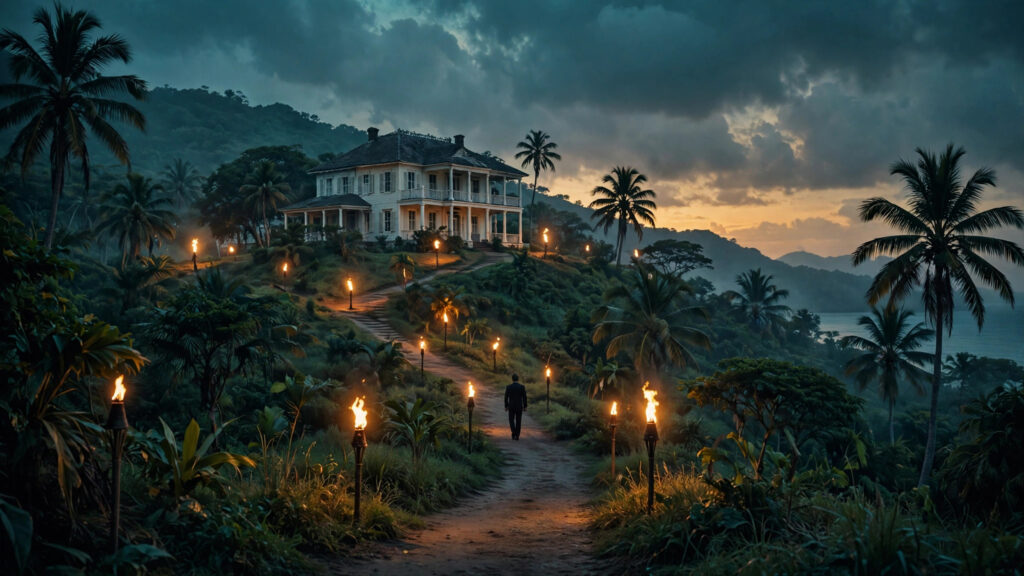
The Short Answer
The Live and Let Die ending explained in one paragraph: Dr. Kananga, the prime minister of the fictional Caribbean island of San Monique, is also the New York drug lord Mr. Big, and his plan is to flood America with free heroin until the number of addicts doubles, then sell his own supply at monopoly prices.
Bond seduces Kananga’s tarot reader Solitaire, which strips her of the virginity her powers depend on, survives being left on a crocodile farm, and blows up Kananga’s poppy fields with the help of Quarrel Jr. He rescues Solitaire from a voodoo sacrifice, knocks Baron Samedi into a coffin of venomous snakes, and kills Kananga in his underground lair by forcing him to swallow a compressed-gas pellet, which inflates him until he explodes.
On the train home, the henchman Tee Hee tries once more to kill Bond and is thrown from the moving train. The film’s final shot shows Baron Samedi sitting on the front of the train, laughing — and the film never says whether he is alive, a spirit, or simply a legend that refuses to die.
The Live and Let Die ending explained here is the ending of Roger Moore’s first film as James Bond, and it is the strangest finale of the Moore era. A drug-smuggling investigation turns into a voodoo ceremony, a crocodile escape, a record-breaking boat chase and a villain who dies by inflating like a balloon — and then the film ends on a joke that may not be a joke at all.
Released in the United States on 27 June 1973, Live and Let Die is the eighth film produced by Eon Productions and the first to star Roger Moore as James Bond. Directed by Guy Hamilton from a screenplay by Tom Mankiewicz, it is based on Ian Fleming’s 1954 novel of the same name, though the film keeps only the bones of the book. Made for around $7 million, it earned $161.8 million worldwide, proving that the series could survive without Sean Connery.
The official 007 site’s Live and Let Die focus week covers Moore’s casting and the film’s production in detail. The Live and Let Die ending explained below follows the film, not the novel, wherever the two disagree.
This is the Live and Let Die ending explained step by step: what Kananga’s heroin plan actually is, how Bond breaks Solitaire’s powers, why the crocodile run is real, how the boat chase set a world record, how Kananga dies, what happens to Tee Hee on the train, and what Baron Samedi’s last laugh really means.
The Ending in 60 Seconds
Here is the whole Live and Let Die ending explained in 60 seconds, before the detail. Kananga grows heroin poppies on San Monique and protects the fields by keeping the islanders afraid of voodoo and of his priest, Baron Samedi. His plan is to give heroin away free in America until the number of addicts doubles, then sell his own supply at prices no rival can match.
Bond follows the trail from New York to New Orleans to San Monique. He exposes the CIA agent Rosie Carver as Kananga’s double agent, seduces Solitaire and breaks her tarot powers, and is left on a crocodile farm to die. He escapes by running across the backs of the crocodiles, destroys the poppy fields, and rescues Solitaire from being sacrificed by Baron Samedi.
In Kananga’s underground lair, Bond is lowered into a shark tank with Solitaire. He escapes, forces Kananga to swallow a compressed-gas pellet from a shark gun, and Kananga inflates and explodes. On the train home, Tee Hee attacks Bond in his cabin and is thrown from the moving train. The last image of the film is Baron Samedi, who should be dead in a coffin of snakes, sitting on the front of the train and laughing at the camera.
Where the Story Leaves Bond Before the Finale
To understand the Live and Let Die ending explained here, it helps to remember how the film opens. Three MI6 agents are murdered within 24 hours: one at the United Nations headquarters in New York, one in New Orleans during a funeral procession, and one on San Monique during a voodoo ceremony. All three were watching the same man — Dr. Kananga, the prime minister of San Monique, who is visiting New York.
M sends Bond to find out why. In New York, Bond meets Felix Leiter of the CIA, played by David Hedison, and is taken to meet Mr. Big, the head of a Harlem drug gang who runs a chain of restaurants called Fillet of Soul. Mr. Big sits in a chair that snaps steel bands around Bond’s wrists, and then does something no Bond villain had done before: he pulls off his own face.
The prosthetic makeup comes away, and Mr. Big is Kananga. The prime minister and the drug lord are the same man.
Kananga’s fortune teller is Solitaire, played by Jane Seymour in her first major film role. She reads tarot cards for Kananga, and her cards keep showing Bond — including, to Kananga’s fury, a card showing Bond as her lover. Bond follows Kananga to New Orleans, where the film gives him its most famous comic relief: Sheriff J.W. Pepper, played by Clifton James, a loud Louisiana lawman who keeps arresting Bond and then keeps needing his help.
On San Monique, Bond meets Rosie Carver, played by Gloria Hendry, a junior CIA agent who is secretly working for Kananga. She is the first Black Bond girl to be romantically involved with 007 on screen, and she is also one of the least competent double agents in the series: her gun safety is on when she tries to threaten Quarrel Jr., and she leads Bond straight into a trap.
When Bond confronts her, she runs — and is shot dead by a gun hidden inside one of Kananga’s scarecrows. It is a cold, quick death, and the film does not mourn her. That is where the Live and Let Die ending explained in this article really begins: Bond is alone on the island, Kananga knows he is there, and Solitaire is the only person left who can help him.
Kananga’s Plan: Free Heroin and a Captive Market
Kananga is the only Bond villain whose plan is a business plan, not a doomsday plot. He has no laser, no satellite, no stolen bomb. He has poppy fields, and a simple idea about how markets work. Anyone coming to the Live and Let Die ending explained for the first time usually starts with the same confusion: why does a drug dealer need voodoo? The answer is that the voodoo is the security system, and the drugs are the business.
The Live and Let Die ending explained below only makes sense once that idea is clear, because everything Kananga does — the voodoo, the murders, the double identity — exists to protect it.
- Grow the product in secret. Kananga grows heroin poppies on San Monique, hidden from the world and guarded by fear. The islanders believe the fields are cursed ground, watched over by Baron Samedi, so nobody goes near them.
- Give it away free. Through his Fillet of Soul restaurants, Kananga plans to distribute heroin free of charge across America. Free drugs put every rival dealer out of business and, more importantly, create new addicts.
- Double the market. Kananga’s own estimate is that free heroin will double the number of addicts in America. Once that happens, he stops giving it away.
- Sell at monopoly prices. With the competition destroyed and demand doubled, Kananga becomes the only supplier. He can charge whatever he likes, and the addicts he created have no choice but to pay.
- Hide behind a flag. As prime minister of San Monique, Kananga has diplomatic cover, a government, and a legitimate reason to travel. As Mr. Big, he has the streets. Neither identity can be touched without exposing the other — until Bond pulls the face off.
That is why the ending has to destroy the fields, not just kill the man. If Bond only killed Kananga, the poppies would still be there, and someone else would harvest them. The film understands this, which is why the climax is a demolition job: explosives in the poppy fields first, Kananga second. It is also why Kananga is, in his own way, the most realistic villain of the Moore era. He is not trying to rule the world. He is trying to corner a market, and his weapon is a free sample.
Solitaire, the Tarot Cards and the Lovers
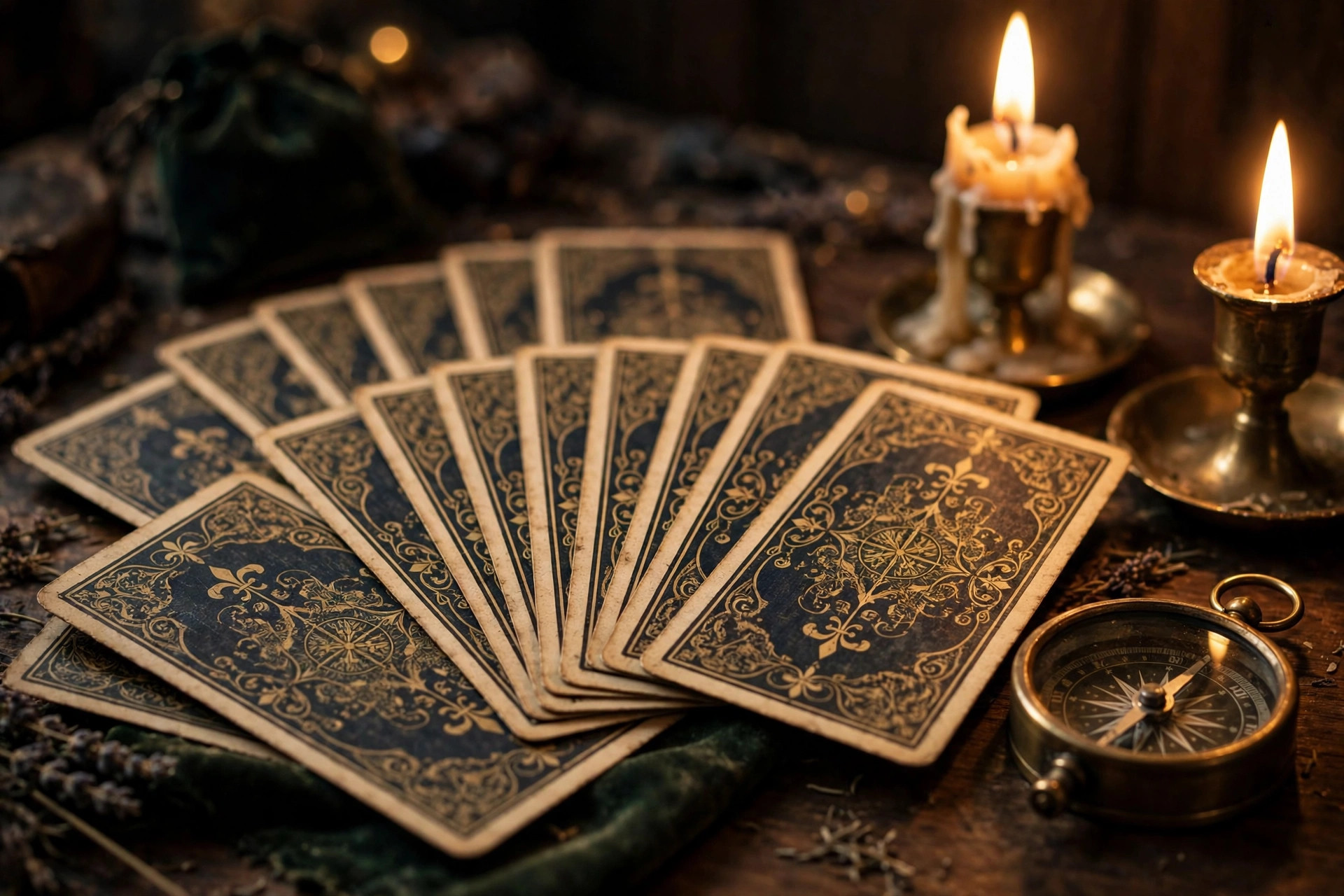
The Live and Let Die ending explained here turns on a tarot trick, and it is the most argued scene in the film. Solitaire can see the future in her cards, but only while she remains a virgin. Kananga keeps her close because her readings are accurate: she warns him about Bond before Bond even arrives, and her cards keep showing the two of them together.
Bond’s answer is a cheat. He stacks her tarot deck so that every card she draws is The Lovers, the card that shows a man and a woman together. Solitaire reads the rigged deck as fate: the cards say she and Bond are meant to be together, so she sleeps with him. In the morning, her powers are gone. The cards show her nothing. Kananga, who can tell from her reading that she has lost her gift, is furious — not because she betrayed him, but because the tool he depended on has stopped working.
It is worth saying plainly that this scene has aged badly, and modern viewers are right to be uncomfortable with it. Bond tricks a sheltered young woman into bed by rigging the only belief system she has. The film plays it as a clever seduction, and Jane Seymour plays Solitaire as someone who genuinely believes the cards have spoken. But the mechanics of the plot are simple and the film never hides them: Solitaire’s virginity is treated as a battery for her powers, and Bond drains it on purpose.
That choice drives the whole finale. Once Solitaire has lost her powers, Kananga has no more use for her as a seer, so he hands her to Baron Samedi to be sacrificed. Her death is meant to be a public warning to the islanders: this is what happens to people who betray Kananga. Bond’s rescue of her is therefore not just a rescue. It is the moment Kananga’s control over San Monique breaks in front of the people he has been frightening for years.
The Crocodile Run: The Stunt That Was Real
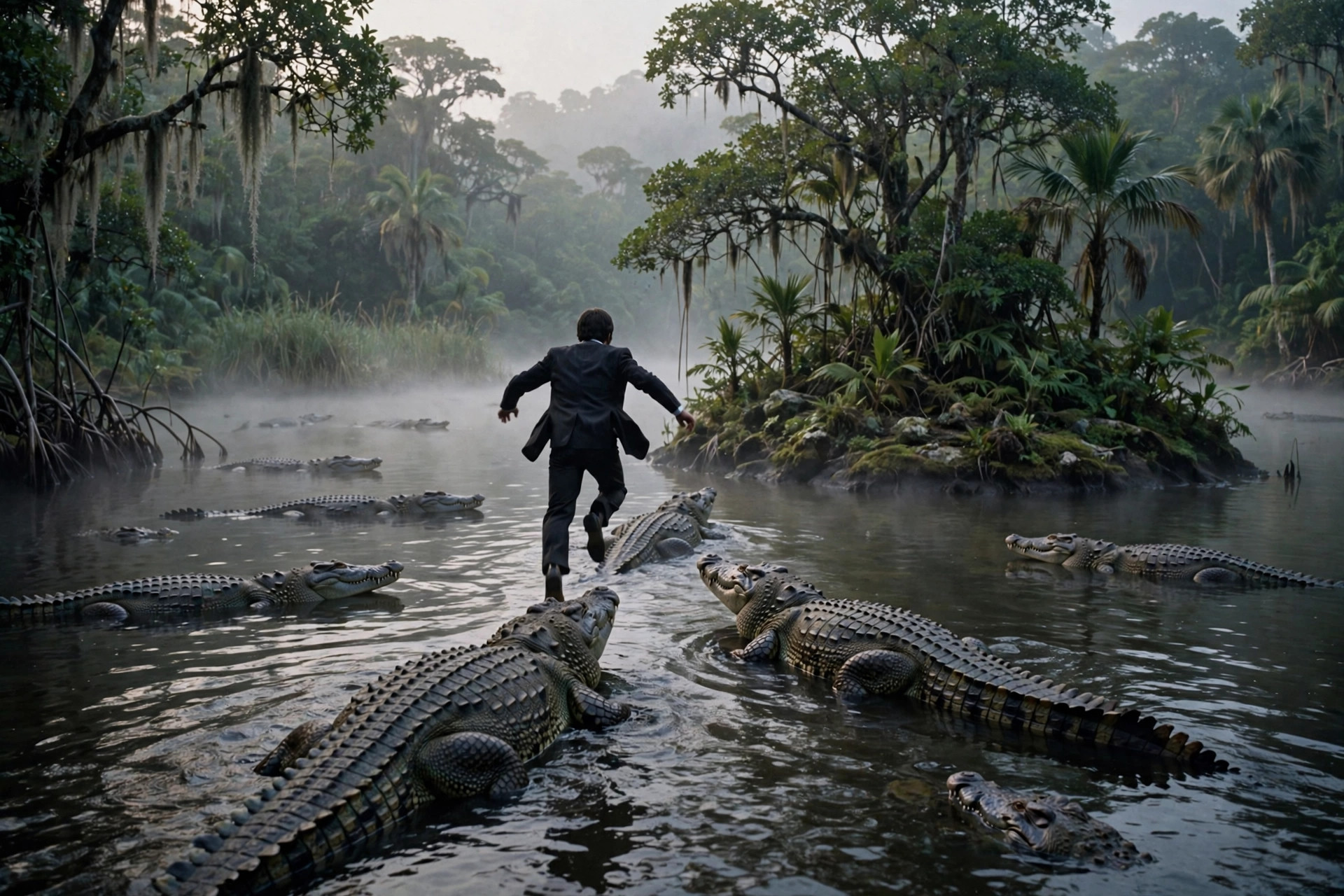
After Solitaire is taken, Kananga’s henchmen Tee Hee and Adam leave Bond on a small island in the middle of a crocodile farm, with no way across. The crocodile run is the moment every Live and Let Die ending explained has to cover, because it is the most famous image in the film: Bond runs across the backs of three live crocodiles to reach the far bank.
What most viewers do not know is that the stunt is real. The farm belonged to Ross Kananga, a crocodile farm owner in Jamaica who ran the Jamaica Swamp Safari. The production found his farm during a location search, liked the sign on the gate — “Trespassers Will Be Eaten” — and built the sequence around it. The film’s villain is even named after him: screenwriter Tom Mankiewicz liked the name Kananga so much that he gave it to Yaphet Kotto’s character.
Ross Kananga suggested the crocodile run himself and performed it in Roger Moore’s clothes, with the crocodiles’ legs tied down but their jaws free. It took several attempts, and on one of them a crocodile snapped at his heel, tearing his trousers and leaving him needing 193 stitches. He was paid $60,000 for the stunt. Moore, sensibly, watched from a safe distance: his close-ups were filmed with foam rubber crocodiles, and the wide shots of the run are Kananga himself.
The scene works because it is honest about what it is. There is no gadget, no trick, no clever line. Bond is trapped, the only way out is across the animals, and he runs. For a Live and Let Die ending explained, the crocodile run matters because it is the moment Bond stops being hunted and starts hunting: it is also the scene that sums up Moore’s Bond. Where Connery’s Bond would have fought his way out, Moore’s Bond runs, improvises, and gets away with a raised eyebrow.
The Boat Chase and Sheriff Pepper
From the crocodile farm, Bond steals a speedboat and the film launches into the boat chase the script had billed as “the most terrific boat chase you have ever seen”. The Live and Let Die ending explained in this guide treats the boat chase as the film’s second act of demolition: the fields are the first, and the bayou is where Kananga’s men lose the war of attrition.
The chase was filmed in the Louisiana bayou around the Irish Bayou area, and the production bought 26 identical Glastron speedboats for it. Seventeen of them were destroyed during filming, smashed into trees, through a wedding tent and into a swimming pool. The script, famously, did not describe the chase at all: for one scene it simply read “the most terrific boat chase you have ever seen”, and the crew worked it out on the water.
The centrepiece is a jump. Stunt driver Jerry Comeaux drove a Glastron GT-150 at a hidden wooden ramp and cleared 110 feet of road and a police car, landing flat in the water on the far side. The jump was recorded by Guinness World Records as the longest filmed speedboat jump in cinema history, a record that stood for three years. It was filmed in a single take, on 16 October 1972, and the boat that followed Comeaux flipped over on landing — an accident the film kept, because it looked even better than the plan.
Running alongside the chase is Sheriff J.W. Pepper, who arrests Bond, loses him, arrests him again, and ends up as an accidental passenger in the whole sequence. Pepper is the film’s comic engine, and Clifton James plays him so broadly that the character was brought back for the next film, The Man with the Golden Gun, in 1974. He is also the reason the boat chase is funny rather than just loud: every time Bond does something impossible, there is a Louisiana sheriff in the next boat shouting about it.

The Final Showdown: How Kananga Dies
The Live and Let Die ending explained in full comes down to two demolitions, one after the other. First, Bond and Quarrel Jr. plant timed explosives across Kananga’s poppy fields. The fields burn, and with them goes the heroin, the free samples, and the whole business plan. Quarrel Jr., played by Roy Stewart, is the son of Quarrel, the fisherman who helped Bond in Dr. No — a quiet piece of continuity the film never makes a fuss about.
Then Bond goes back for Solitaire. Kananga has handed her to Baron Samedi for sacrifice, and Bond reaches her just as the ceremony begins. He fights Samedi, punches him, and Samedi falls into a coffin full of venomous snakes. Bond and Solitaire escape underground into Kananga’s lair, where Kananga captures them both and has them lowered into a shark tank.
This is where Kananga makes the mistake every Bond villain makes: he explains himself instead of killing Bond. While Kananga talks, Bond reaches the shark gun — a weapon that fires compressed-gas pellets used to kill sharks. He forces one of the pellets into Kananga’s mouth. The gas expands inside him, Kananga inflates like a balloon, floats up to the ceiling of the cave, and explodes.
It is one of the strangest villain deaths in the whole series, and it is deliberately undignified. Kananga does not get a duel, a final speech, or a moment of respect. He gets a practical joke played on him with his own equipment, in his own lair, in front of the woman he tried to sacrifice.
The film has spent two hours building Kananga up as a prime minister, a drug lord, and a man who controls an island through fear. It kills him like a popped balloon. No other Bond villain dies this way, which is why the Live and Let Die ending explained here keeps coming back to this one pellet of gas. That is the point: the man who built an empire on free samples is destroyed by something he got for nothing — a single pellet of compressed air.
Tee Hee on the Train and Baron Samedi’s Last Laugh
After the lair, Bond and Solitaire board a train home, and the film has one more killer to deal with. Tee Hee, Kananga’s one-armed henchman, played by Julius Harris, hides in Bond’s cabin. His right arm was lost to a crocodile years ago and replaced with a metal pincer, and he tries to use it on Bond one last time.
Bond traps the metal arm in the train window and throws Tee Hee from the moving train. It is a clean, visible death — the only henchman in the film who is shown dying without any doubt attached. Tee Hee has been the film’s most reliable killer, and he dies the way he lived: quietly, efficiently, and without a speech. For readers coming to the Live and Let Die ending explained for the first time, the train is the part that stays with them, because it is where the film stops answering questions and starts asking them.
Then comes the final shot, and it undoes all of that certainty. As the end credits roll, Baron Samedi is sitting on the front of the train, laughing directly at the camera. He should be dead: Bond knocked him into a coffin of venomous snakes, and nobody could survive that. Yet there he is, in his top hat and white face paint, laughing as if the whole film were a joke he was in on.
The film never explains it. There are three ways to read the shot, and the film refuses to choose between them. The first is that Baron Samedi is a supernatural being — the voodoo god of the dead, who cannot be killed by snakes because he was never alive in the ordinary sense. The second is that he survived the snakes, climbed out of the coffin, and followed the train, which is possible but never shown. The third is that he is not a person at all, but a legend: the islanders’ fear made flesh, and the film’s way of saying that Kananga’s voodoo outlived Kananga.
Whichever reading you prefer, the shot does the same job. It tells the audience that the story is not really over. Kananga is dead, the fields are burned, Tee Hee is gone — but the thing that made San Monique afraid is still sitting on the front of the train, laughing. It is the film’s cleverest ending, and the reason the Live and Let Die ending explained here keeps generating questions fifty years later. Most Bond films end with the threat destroyed. This one ends with the threat waving goodbye.
Film vs Book: What Fleming Actually Wrote
The Live and Let Die ending explained above is mostly an invention of the film. Fleming’s 1954 novel, his second Bond book, was published in the UK by Jonathan Cape on 5 April 1954. It is a Harlem crime story, not a Caribbean voodoo story, and the film keeps only the characters and the skeleton of the plot.
What the film keeps from the novel is Mr. Big, Solitaire, Tee Hee, and the tarot cards. What it invents is almost everything that makes the ending memorable: the fictional island of San Monique, Kananga as a prime minister, the poppy fields, the free-heroin plan, the crocodile farm, the boat chase, and Baron Samedi’s last laugh.
That is why any Live and Let Die ending explained has to keep the book and the film separate: the novel’s ending is quieter, and the film’s ending is louder, stranger, and far less tidy. Even the film’s most famous script line — “the most terrific boat chase you have ever seen” — was a blank in the script that the crew filled in on the Louisiana bayou.
The comparison is useful because it shows what the film was trying to do. Fleming wrote a crime story about a Harlem gangster smuggling gold coins. The film needed a finale big enough for a new Bond, so it moved the story to the Caribbean, gave the villain a country to rule, and gave Bond a voodoo priest to beat.
The novel’s ending is quieter: Bond’s limpet mine explodes under Mr. Big’s yacht, Mr. Big survives the blast only to be killed by the sharks and barracuda, and Bond and Solitaire are rescued and recuperate on a Jamaican beach. The film’s ending is louder, stranger, and far less tidy — which is exactly why people are still explaining it.
| Element | Fleming’s 1954 novel | The 1973 film |
|---|---|---|
| Main villain | Mr. Big, a Harlem gangster | Dr. Kananga, prime minister of San Monique, who is also Mr. Big |
| Setting | Harlem, New York, Florida and Jamaica | New York, New Orleans, Louisiana bayou and the fictional island of San Monique |
| The scheme | Gold smuggling and drug dealing | Free heroin to double the number of addicts, then a monopoly |
| Solitaire | Tarot reader held by Mr. Big | Tarot reader whose powers depend on her virginity; Bond rigs her deck with The Lovers |
| Felix Leiter | Mauled by a shark and left with the note “He disagreed with something that ate him” | Unharmed throughout; helps Bond in New York and New Orleans |
| Quarrel | Dies helping Bond | His son, Quarrel Jr., helps Bond and plants the explosives in the poppy fields |
| Baron Samedi | No on-screen Baron Samedi; Mr. Big claims to be the zombie of Baron Samedi, the voodoo prince of darkness | Voodoo priest who survives a coffin of snakes and laughs on the front of the train |
| Kananga’s death | Mr. Big survives Bond’s limpet mine, then is killed by sharks and barracuda | Kananga swallows a compressed-gas pellet, inflates and explodes |
Timeline: Live and Let Die, End to End
The Live and Let Die ending explained here only makes full sense in the context of what came before it and what followed. Here is the timeline that frames it.
- 5 April 1954: Ian Fleming’s novel Live and Let Die is published in the UK by Jonathan Cape. It is the second Bond book.
- 1961: Fleming names Roger Moore as his choice to play James Bond. Moore is busy with The Saint, and Sean Connery gets the role instead.
- December 1971: Diamonds Are Forever is released. Connery leaves the role, and the producers begin the search for a new 007.
- 13 October 1972: Filming begins in Louisiana with the boat chase. Three days later, stunt driver Jerry Comeaux makes the record-breaking 110-foot boat jump.
- December 1972: The production moves to Jamaica, where it finds Ross Kananga’s crocodile farm and builds the crocodile run around it.
- 27 June 1973: Live and Let Die opens in the United States. The London premiere follows on 6 July 1973.
- 1973–74: The film earns $161.8 million worldwide on a $7 million budget. Paul McCartney and Wings’ theme song becomes the first Bond theme nominated for the Academy Award for Best Original Song; it loses to “The Way We Were” but wins a Grammy for Best Arrangement Accompanying Vocalist(s).
- 1974: Moore returns as Bond in The Man with the Golden Gun, with Sheriff J.W. Pepper returning alongside him. He would play the role seven times over the next twelve years.
5 Key Answers About the Live and Let Die Ending
Here are the five answers that matter most in the Live and Let Die ending explained, in one place.
- Kananga’s plan is a free-sample monopoly. He grows heroin poppies on San Monique, protected by voodoo fear, and plans to give heroin away free in America until the number of addicts doubles. Then he sells his own supply at prices no rival can match. Bond has to burn the fields, not just kill the man.
- Solitaire loses her powers because Bond rigs her cards. Her gift depends on her virginity. Bond stacks her tarot deck so every card is The Lovers, she reads it as fate, sleeps with him, and wakes up unable to see the future. Kananga hands her to Baron Samedi for sacrifice, which is what sends Bond back to rescue her.
- The crocodile run is real. Stuntman Ross Kananga, the owner of the Jamaican crocodile farm where the scene was filmed, performed the run himself in Roger Moore’s clothes. He needed 193 stitches after a crocodile snapped at his heel, and the film’s villain is named after him.
- Kananga dies by inflating like a balloon. Bond forces a compressed-gas pellet from a shark gun into Kananga’s mouth. The gas expands, Kananga floats to the ceiling of his own lair, and he explodes. There is no duel and no final speech.
- Baron Samedi’s survival is never explained. Bond knocks him into a coffin of venomous snakes, but the final shot shows him sitting on the front of the train, laughing at the camera. Whether he is a spirit, a survivor or a legend is left for the audience to decide — and the film is better for refusing to answer.
Our Take
Live and Let Die has the strangest ending of any Roger Moore Bond film, and that is exactly why it is worth explaining properly. The film is really two stories stitched together: a Harlem crime story taken from Fleming, and a Caribbean voodoo story invented for the screen. The crime story gets a clean ending — the fields burn, the villain explodes, the henchman is thrown from a train. The voodoo story does not: the priest survives, the legend laughs, and the film ends on a question instead of an answer.
That split is the film’s real legacy, and it is why the Live and Let Die ending explained in this article spends as much time on what is left open as on what is blown up. It showed the series that a Bond finale could be a demolition job and a ghost story at the same time, and every later film that ends with an unexplained survivor owes something to Baron Samedi sitting on the front of that train.
It also showed the limits of the Moore era’s lightness: the film is so busy being fun that it never stops to ask whether tricking Solitaire into bed was a clever plan or a cruel one, and modern viewers are right to notice.
Our verdict: the Live and Let Die ending explained above is not a tidy ending, it is a confident one. The tarot trick, the crocodile run, the record-breaking boat jump and the exploding villain are all good Bond material, and the final laugh is the best last shot of Moore’s seven films.
What is missing is thirty seconds of film: one shot of how Samedi got out of that coffin, one line confirming whether he is a man or a spirit. The film never gives it, and the argument about Baron Samedi has been running ever since — which, for a fan site, is almost as good as a perfect ending.
Read Also:
Read Also: James Bond Movies: The Complete 007 Film Guide (1962–2026)
Read Also: Diamonds Are Forever Ending Explained: Blofeld, the Satellite and the Cruise Ship
Read Also: You Only Live Twice Ending Explained: Blofeld, Bird One and the Volcano Base
How does Kananga die in Live and Let Die?
Bond forces Kananga to swallow a compressed-gas pellet from a shark gun. The gas expands inside him, Kananga inflates like a balloon, floats up to the ceiling of his underground lair, and explodes. It is one of the strangest villain deaths in the series, with no duel and no final speech.
Does Baron Samedi die in Live and Let Die?
The film never says. Bond knocks Baron Samedi into a coffin full of venomous snakes during the rescue of Solitaire. But the final shot of the film shows Samedi sitting on the front of the train, laughing at the camera. Whether he is a spirit, a survivor or a legend is left for the audience to decide.
Why does Solitaire lose her powers?
Solitaire can see the future in her tarot cards only while she remains a virgin. Bond stacks her deck so that every card she draws is The Lovers, she reads the rigged deck as fate, and she sleeps with him. In the morning her powers are gone, and Kananga, furious that his seer can no longer see, hands her to Baron Samedi to be sacrificed.
What is Kananga’s plan in Live and Let Die?
Kananga grows heroin poppies on San Monique and plans to give heroin away free in America through his Fillet of Soul restaurants. Free drugs would put his rivals out of business and double the number of addicts. Once demand has doubled, he stops giving it away and sells his own supply at monopoly prices.
Is Live and Let Die based on a book?
Yes. The film is based on Ian Fleming’s 1954 novel of the same name, his second Bond book. The film keeps Mr. Big, Solitaire, Tee Hee and the tarot cards, but invents the island of San Monique, Kananga as a prime minister, the poppy fields, the crocodile run, the boat chase and Baron Samedi’s last laugh.

Kunal Chaudhary is the founder and editor of Media1Gyan, covering Bond 26 casting news, rankings and Bond history since July 2026, sourcing every developing story from trade reporting and official announcements and labelling rumor separately from confirmed fact. Kunal is the founder and editor of Media1Gyan.com, an independent James Bond 007 fan blog. A lifelong James Bond fan, he started Media1Gyan to give fellow fans clear, well-researched coverage of the world of 007 — from the classic Eon films to the new Amazon-MGM era and the road to Bond 26. On Media1Gyan, Kunal covers Bond movie news and casting rumors, ranked listicles (villains, Bond girls, theme songs, gadgets), explainers on Bond history and trivia, and deep dives into characters like Vesper Lynd and Ernst Stavro Blofeld. Every article is researched from publicly available information and reliable sources, and reviewed for accuracy before publishing. His approach is fan-first: no hype without sourcing, no rumors presented as fact, and complex Bond lore explained in plain language. When he covers developing stories like the next James Bond casting, articles are updated as new information breaks. Follow Media1Gyan.com for daily James Bond coverage — news, rankings, and guides for fans around the world. He writes under his real name.