The Short Answer
The Man with the Golden Gun ending explained in one paragraph: a golden bullet engraved with 007 arrives at MI6, and Bond traces it to Francisco Scaramanga, an assassin who charges one million dollars per kill and fires a golden gun assembled from a pen, a lighter, a cigarette case and a cufflink. Scaramanga has stolen the Solex Agitator, a device that can harness the power of the sun, and plans to sell it to the highest bidder.
On Scaramanga’s private island, the assassin challenges Bond to a pistol duel on the beach. After twenty paces Bond turns and fires, but Scaramanga has vanished into his funhouse. Bond wins by posing as his own wax mannequin, and when Scaramanga shoots the dummy, Bond shoots him dead.
Meanwhile Mary Goodnight kills Scaramanga’s security chief Kra, whose fall into a vat of liquid helium sends the solar plant out of control. Bond grabs the Solex, escapes with Goodnight in Scaramanga’s junk, traps the manservant Nick Nack in a suitcase hung from the mast, and sails away as the island’s power plant destroys itself.
The Man with the Golden Gun ending explained here is one of the strangest finales in the whole Bond series. There is no countdown clock, no army of henchmen and no villain’s speech about ruling the world. Instead, the ninth Bond film ends with a polite lunch, a duel at twenty paces, a killer hiding behind wax dummies, and a manservant locked in a suitcase. It is a small, personal ending for a film about a very large idea: the energy crisis of the 1970s, and what a weaponised sun could do in the wrong hands.
The film was released in December 1974, nine months after Roger Moore’s debut in Live and Let Die, and it is the second film to star Moore as 007. The Man with the Golden Gun ending explained in this guide covers the film, not the novel, except where the two differ.
It was directed by Guy Hamilton, his fourth and final Bond film, from a screenplay by Richard Maibaum and Tom Mankiewicz. The story is loosely based on Ian Fleming’s 1965 novel of the same name, the author’s final Bond book, published after his death. The film keeps Fleming’s duel and the golden gun, but moves the action from Jamaica to Hong Kong, Bangkok and Thailand, and adds the Solex, a solar-energy device that did not exist in the book.
This guide walks through the ending beat by beat: who sent the golden bullet, what the Solex really is, why Scaramanga insists on a fair duel, how Bond turns the funhouse against its owner, and what happens to everyone left standing when the island explodes.
The Ending in 60 Seconds
The Man with the Golden Gun ending explained in brief runs like this. Bond follows Scaramanga to a private island in Phang Nga Bay, Thailand, the place now known to tourists as James Bond Island. Scaramanga shows Bond his solar power plant and uses a solar-powered beam to destroy Bond’s seaplane, so there is no way off the island except through him.
Over lunch, Scaramanga proposes a pistol duel on the beach, the old-fashioned kind, with his manservant Nick Nack officiating. The two men take twenty paces, turn and fire. Scaramanga has disappeared. That vanishing act is the twist the Man with the Golden Gun ending explained here turns on. Nick Nack leads Bond into the funhouse, a maze of mirrors, wax figures and booby traps where Scaramanga has killed before.
Bond wins the duel by cheating it honestly. He finds a wax mannequin of himself in the funhouse, takes its place, and waits. Scaramanga fires at the dummy, and in that moment Bond sees where the shot came from and fires back. Scaramanga dies on the floor of his own funhouse, killed by the one man he respected enough to duel.
While the duel is happening, Mary Goodnight is fighting for her own life in the solar plant. She kills Scaramanga’s security chief Kra, and Kra’s body falls into a vat of liquid helium. The plant’s temperature spirals out of control. Bond grabs the Solex unit, runs for the junk with Goodnight, and the two escape as the plant tears itself apart. Nick Nack sneaks aboard for one last attack, and Bond traps him in a suitcase and hangs it from the mast. The film closes with Bond and Goodnight sailing away together, and the end credits promise that James Bond will return in The Spy Who Loved Me.

What Is the Solex Agitator?
The Solex Agitator is the object everyone in the film is chasing, and it is worth understanding before the ending makes sense. It is a small device invented by a British scientist named Gibson, and it can harness the power of the sun. In the world of the film, released in the middle of the 1973 energy crisis, that makes it the most valuable object on Earth. Whoever controls the Solex controls cheap, limitless energy, and whoever controls the energy controls the world.
The Man with the Golden Gun ending explained properly starts with the Solex, because the whole plot is a race for it. Gibson is murdered by Scaramanga outside the Bottoms Up Club in Hong Kong, and Scaramanga’s manservant Nick Nack steals the Solex from Gibson’s body. Scaramanga does not want to use the device to save the world. He wants to sell it to the highest bidder, and he has already built a solar power plant on his island to prove that it works.
The Man with the Golden Gun ending explained for the Solex turns on this demonstration. Scaramanga proves the device works in the most frightening way possible. When Bond arrives on the island by seaplane, Scaramanga takes him to the plant and demonstrates the solar-powered beam. He aims it at Bond’s own aircraft and destroys it in front of him. The message is clear: this is not a laboratory toy. It is a weapon, and Bond is now trapped on the island with the only man who controls it.
That is why Bond must take the Solex back with him at the end. Killing Scaramanga is not enough. If the device stays on the island, it burns with the plant, and the world loses the answer to the energy crisis. If it falls into the wrong hands, it becomes a weapon for sale. So the final moments of the film are not only about the duel. They are about Bond grabbing the Solex unit from the dying plant and carrying it out, which is the real mission all along.
Who Is Francisco Scaramanga?
Francisco Scaramanga, played by Christopher Lee, is the villain the film is named after, and he is unusual among Bond villains. He is not a terrorist, not a megalomaniac and not a man with a plan for world domination. He is a freelance assassin who charges one million dollars per kill, and he is very good at his job. The film’s own briefing describes him as the best shot in the world, a man with no known photograph and only one identifying mark: a third nipple.
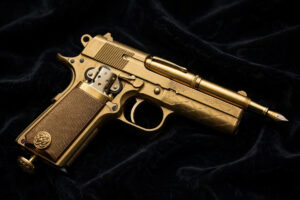
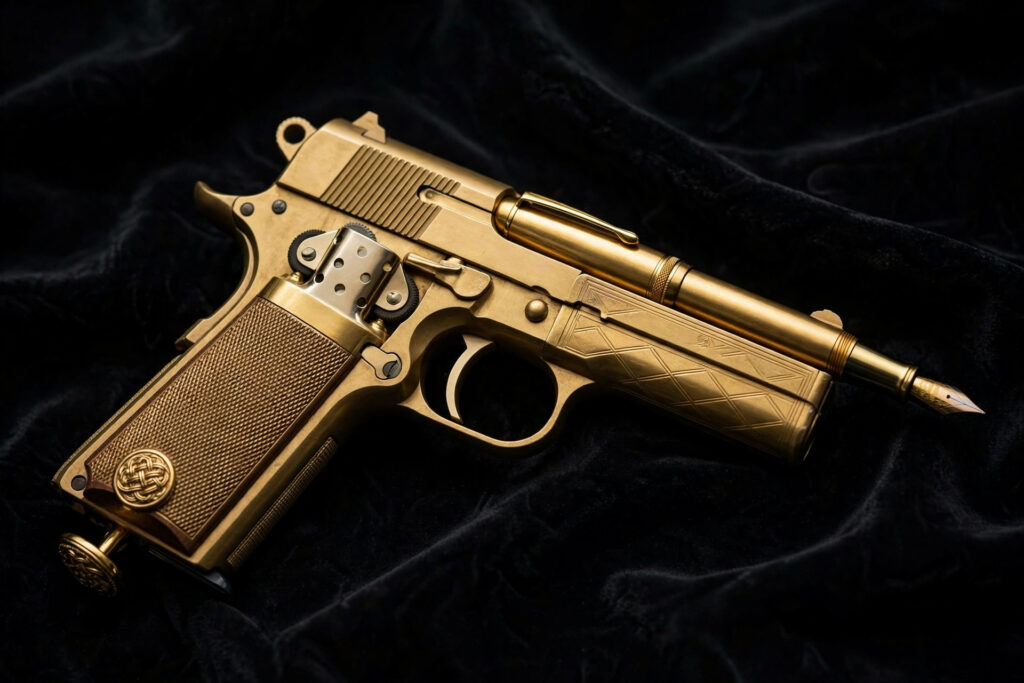
His weapon is the golden gun of the title. It is a single-shot pistol that assembles from four ordinary objects: a gold cigarette case forms the handle, a gold lighter forms the bullet chamber, a gold fountain pen forms the barrel, and a gold cufflink works as the trigger.
It fires a single 4.2-millimetre gold bullet, made for him by a gunsmith named Lazar in Macau. Scaramanga carries his spare bullets in his belt, and he never misses. It is the weapon the whole Man with the Golden Gun ending explained in this guide builds towards.
Christopher Lee was Ian Fleming’s step-cousin and regular golf partner, and Fleming had wanted Lee for a Bond film for years. Critics at the time praised Lee’s performance even while they criticised the film around him, and many fans still call Scaramanga the finest villain of the Roger Moore era. The reason is simple: Scaramanga is Bond’s mirror image. He is the same age, the same class, the same skill, and the same cold professionalism, except that he kills for money and Bond kills for Queen and country.
That mirror-image idea is the whole point of the Man with the Golden Gun ending explained here. Scaramanga does not try to trap Bond or outnumber him. He challenges him to a duel, because he genuinely wants to know which of them is the better killer. His pride is his weakness, and the duel is the trap he sets for himself.

Why Andrea Anders Sends the Golden Bullet
The film opens with a mystery: a golden bullet engraved with 007 arrives at MI6 in London. Everyone assumes Scaramanga has sent it as a threat, a warning that Bond is his next target. The truth is sadder, and it explains the whole middle of the film.
Andrea Anders, played by Maud Adams, is Scaramanga’s girlfriend, and she sent the bullet herself. She wants Bond to kill Scaramanga, because she is frightened of the man she lives with and sees no other way out. It is the first thread of the Man with the Golden Gun ending explained in this article. She promises Bond that if he kills Scaramanga, she will give him the Solex. It is a desperate bargain from a woman with no choices left, and it costs her everything.
Bond follows the bullet from a belly dancer named Saida in Beirut, who carries a spent golden bullet, to the gunsmith Lazar in Macau, who makes the bullets, and then to Anders herself in Hong Kong. She tells Bond where to find Gibson, and Scaramanga kills Gibson moments later. Anders has already betrayed her lover, and Scaramanga knows it.
The Man with the Golden Gun ending explained for Anders is brutal and brief. At a Muay Thai boxing match the next day, Bond finds her sitting silently in the crowd. She is already dead, killed by a single golden bullet to the heart. Scaramanga sits beside her body and introduces himself to Bond for the first time, calmly, as if nothing has happened.
Anders is the film’s real victim, and her death is the moment the story turns personal. Bond is no longer chasing a device. He is chasing the man who murdered a woman for asking for help.
Maud Adams would return to the series nine years later in a different role, playing Octopussy in the 1983 film of the same name. She is the only actress to play two different leading Bond women in the Eon series.
The Road to the Island: Hai Fat, Pepper and the Flying Car
Between the murder of Anders and the duel on the island, the film takes Bond through Bangkok and into the most famous car chase in the series. The chase matters to the Man with the Golden Gun ending explained here, because it is how Scaramanga gets away, and how Bond ends up with no way home.
Bond travels to Bangkok to meet Hai Fat, a wealthy Thai industrialist suspected of hiring Scaramanga to kill Gibson. Because nobody knows what Scaramanga looks like, except for the third nipple, Bond pretends to be him, showing off a fake third nipple at dinner.
The trick backfires badly. Scaramanga is already working for Hai Fat, and he is standing in the next room. Bond is captured and taken to Hai Fat’s martial arts academy, where students fight to the death and Bond is ordered to fight a champion named Chula. He escapes with the help of Lieutenant Hip and Hip’s two nieces, and flees down the river in a long-tail boat.
Scaramanga then kills Hai Fat with his golden gun and takes over his empire and the Solex. The Man with the Golden Gun ending explained in full has to include Hai Fat’s death, because it hands Scaramanga the Solex and the island. It is a cold business decision. Hai Fat hired him, but Hai Fat is no longer useful, and Scaramanga does not share power with anyone.
Meanwhile, Mary Goodnight, Bond’s MI6 assistant, has followed Nick Nack and tried to plant a homing device on Scaramanga’s car. Scaramanga catches her and locks her in the boot of the car. Bond steals an AMC Hornet from a showroom to give chase, and finds Sheriff J.W. Pepper sitting inside it. Pepper, played by Clifton James, is the Louisiana sheriff from Live and Let Die, on holiday in Thailand, and he spends the whole chase shouting at Bond from the passenger seat.
The chase matters to the Man with the Golden Gun ending explained here, and it ends with the most famous stunt in the film. Bond drives the Hornet at a broken bridge, jumps the river, and the car performs a complete 360-degree corkscrew roll in mid-air before landing on the other side.
The stunt was first worked out as a computer simulation by the Cornell Aeronautical Laboratory, then performed in one take by stunt driver Loren “Bumps” Willert, who received a bonus of 30,000 dollars on the spot. It entered the Guinness Book of Records as the first astro spiral jump on film. The composer John Barry added a slide-whistle sound effect over the jump, a decision he later regretted, saying it broke the golden rule for a genuinely dangerous moment.
Scaramanga escapes the chase in the strangest getaway vehicle in Bond history. His AMC Matador drives into a hangar and converts into an aeroplane, wings folding out, and flies away with Goodnight still locked in the boot. Bond follows the homing signal in a seaplane, and that is how he reaches the island, a place the film calls “Red Chinese waters” and the audience knows as Khao Phing Kan in Phang Nga Bay, Thailand. Today the island is known around the world as James Bond Island, and tourists visit it by the boatload every day.
The Duel: Twenty Paces on the Beach
The Man with the Golden Gun ending explained at its heart is a duel, and the film treats it with unusual seriousness. Over lunch on the island, Scaramanga proposes it in the old-fashioned way: pistols at dawn, twenty paces, one shot each, with Nick Nack officiating. He does not have to offer this. He has Bond trapped on an island, outnumbered, with his seaplane destroyed. He could simply have his men kill Bond. Instead he offers a fair fight, because a fair fight is the only contest that means anything to him.
Nick Nack, who stands to inherit the island if Scaramanga dies, sets the rules and counts the paces. The two men stand back to back on the beach, walk twenty paces apart, turn and fire. Bond turns and fires, and Scaramanga has vanished. The beach is empty. The duel has already become a trick, and the trick is Scaramanga’s home ground.
This is the cleverest idea in the Man with the Golden Gun ending explained here. Scaramanga has spent years building a funhouse on his island, a maze of mirrors, wax figures, trapdoors and pop-up gunmen, and he practises duelling in it every day. The opening scene of the film shows him doing exactly that, killing a visiting gangster named Rodney in the funhouse after letting him wander through it. Scaramanga does not fight fair duels on open beaches. He fights rigged duels in a house he designed, where he knows every hiding place and every mirror.
Bond follows him inside, and the film slows down into something closer to a horror film than a spy film. The funhouse is dark, the mirrors throw back false images, and wax figures of gangsters and cowboys stand in the shadows with guns. Somewhere in there is a real man with a real golden gun, and Bond has six bullets in his Walther PPK against Scaramanga’s one. It is the only advantage Bond has, and it is not much of one against a man who never misses.
The Funhouse: How Bond Kills Scaramanga
Bond wins the duel by turning Scaramanga’s own funhouse against him, and that reversal is the centre of the Man with the Golden Gun ending explained in this guide. Deep inside the maze, he finds a wax mannequin of himself, one of the figures Scaramanga keeps as trophies of the men he has killed. Bond takes the mannequin’s place, standing still in the shadows, waiting, while Scaramanga hunts for him in the dark.
Scaramanga sees the figure, believes it is Bond, and fires. The golden bullet hits the wax dummy. In that instant, the muzzle flash and the sound give away exactly where Scaramanga is standing, and Bond fires back. One shot is all it takes. Scaramanga falls dead on the floor of his own funhouse, killed by the trick he built to kill other men.
The Man with the Golden Gun ending explained this way shows why the duel matters. Scaramanga’s pride demanded a contest between equals, and his funhouse was supposed to guarantee that he would win it. But the funhouse only works if the hunter knows which figure is real and which is wax. Bond understood that faster than Scaramanga did, and the man who charged a million dollars a shot died to a single bullet from a man he had invited to a fair fight.
There is a quiet irony in the weapon, too. Scaramanga’s golden gun fires one bullet at a time, and it must be assembled from four pieces before it can fire at all. Bond’s Walther PPK holds six bullets and is always ready. In a duel in the dark, against a man who never misses, the second shot matters more than the first, and Bond is the only man in the room who has one.

Goodnight, Kra and the Exploding Plant
While Bond is fighting the duel, Mary Goodnight is fighting a battle of her own in the solar plant, and hers is the fight that destroys the island. Goodnight has been a prisoner since Scaramanga locked her in the boot of his car, and she is inside the plant when the duel begins. She is not a trained killer, and the film does not pretend otherwise. She survives by luck, stubbornness and one well-aimed blow.
Goodnight kills Scaramanga’s security chief, a huge man named Kra, during a struggle in the plant. Kra falls into a vat of liquid helium, and the plant’s temperature begins to spiral out of control. Liquid helium is used to keep the solar equipment cold, and without it the system overheats fast. Alarms sound, the machinery shakes, and the plant starts to tear itself apart.
Bond reaches the plant as it is dying. He grabs the Solex unit from the control room, the small device the whole film has been about, and runs with Goodnight for Scaramanga’s junk, the wooden sailing boat moored at the island. Behind them, the solar plant explodes, and the island that Scaramanga built his empire on destroys itself in a fireball.
The film does not linger on the explosion. It cuts to the junk, already sailing away, because the point is not the destruction. The point is that Bond got the Solex out.
Goodnight’s role in the Man with the Golden Gun ending explained here is easy to miss, and it is worth stating plainly. Bond kills Scaramanga, but Goodnight destroys the plant. Without her, the solar weapon would still be standing on the island after Scaramanga’s death, ready for the next buyer. Her fight with Kra is the reason the island explodes, and the reason the Solex is the only piece of the technology that survives.
Nick Nack and the Suitcase
The Man with the Golden Gun ending explained here has one more surprise after the duel and the explosion, and it belongs to the smallest man in the story. Nick Nack, played by Herve Villechaize, is Scaramanga’s manservant, chef and henchman, and he has been loyal to his master through the whole film. He officiated the duel, and he stood to inherit the island if Scaramanga died. When the island explodes, he loses everything: his master, his home and his inheritance.
Nick Nack sneaks aboard the junk as Bond and Goodnight sail away, hiding above deck with a bottle, waiting for his moment. He attacks Bond in a last, desperate attempt at revenge, and for a moment the film turns into a comedy.
Bond is bigger, stronger and better armed, and the fight is short. Bond catches Nick Nack, stuffs him into a suitcase, and hangs the suitcase from the mast of the junk. It is the last surprise in the Man with the Golden Gun ending explained in this guide.
The Man with the Golden Gun ending explained for Nick Nack is simple: no, he does not die. He ends the film trapped in a suitcase, swinging from the mast, while Bond and Goodnight sail on below him. It is a joke ending for a joke character, and it fits the tone of a film that has always mixed menace with comedy. The assassin is dead, the plant is destroyed, the Solex is safe, and the manservant is luggage.
Nick Nack’s fate also answers a question the duel raised. He told Bond before the duel that he would inherit the island if Bond killed Scaramanga. The island is now a burning wreck, the plant is gone, and the inheritance is a suitcase. The film’s final joke is that the man who wanted everything ends up with nothing, and the man who wanted nothing but a fair fight ends up dead.
The Final Shot and What Comes Next
The last shot of the film is Bond and Goodnight alone on the junk, sailing away from the burning island, with Nick Nack swinging in his suitcase overhead. There is no return to London, no debrief with M, and no scene of the Solex being handed over.
The Man with the Golden Gun ending explained above closes without a medal, a briefing or a hero’s welcome. The film simply fades out on the two of them together, and the end credits promise that James Bond will return in The Spy Who Loved Me.
That promise took three years to keep. The Man with the Golden Gun earned 97.6 million dollars on a budget of 7 million, which sounds healthy, but it was the fourth lowest-grossing film in the series, and its returns were well below those of Live and Let Die.
The producers’ partnership broke up after the film: Harry Saltzman sold his fifty percent stake in Danjaq, the parent company of Eon Productions, to United Artists, and legal wrangling over the Bond property delayed the next film for three years. The Spy Who Loved Me did not arrive until 1977.
History has been kinder to the film than the box office was. The duel, the golden gun and Christopher Lee’s performance are now remembered as the best things in a film that critics at the time called the lowest point in the series.
The island, Khao Phing Kan, became one of the most visited film locations in the world. And one of the three golden gun props made for the film was stolen from Elstree Props in 2008, a prop estimated to be worth around 80,000 pounds, which tells you everything about how much the gun itself is now worth to collectors.
The Ending, Step by Step
Here is the Man with the Golden Gun ending explained as a numbered sequence, so you can follow it scene by scene.
- A golden bullet engraved with 007 arrives at MI6, and Bond traces it from Saida in Beirut to the gunsmith Lazar in Macau.
- Andrea Anders tells Bond that she sent the bullet, because she wants him to kill Scaramanga and will give him the Solex in return.
- Scaramanga murders the scientist Gibson outside the Bottoms Up Club in Hong Kong, and Nick Nack steals the Solex Agitator from the body.
- Bond is taken to Hai Fat’s martial arts academy in Bangkok, escapes with Lieutenant Hip and his nieces, and Scaramanga kills Hai Fat and takes over his empire.
- Scaramanga murders Anders with a golden bullet to the heart at a Muay Thai match, then introduces himself to Bond.
- Goodnight is locked in the boot of Scaramanga’s car, and Bond chases him through Bangkok in a stolen AMC Hornet, with Sheriff J.W. Pepper in the passenger seat.
- Scaramanga’s AMC Matador converts into an aeroplane and flies to his island, and Bond follows the homing signal in a seaplane.
- Scaramanga demonstrates the solar beam by destroying Bond’s seaplane, then challenges Bond to a pistol duel on the beach.
- After twenty paces, Scaramanga vanishes into his funhouse, and Bond kills him by posing as his own wax mannequin.
- Goodnight kills the security chief Kra, whose fall into a vat of liquid helium sends the solar plant out of control.
- Bond grabs the Solex, escapes with Goodnight in Scaramanga’s junk, and the plant destroys itself behind them.
- Nick Nack sneaks aboard for a final attack, and Bond traps him in a suitcase hung from the mast as the film fades out.
Timeline: The Man with the Golden Gun in the Bond Story
The Man with the Golden Gun ending explained in this guide sits in a particular moment of Bond history, and the dates around it explain why the film nearly ended the series.
| Date | Event |
|---|---|
| 1 April 1965 | Ian Fleming’s novel The Man with the Golden Gun is published, eight months after the author’s death. |
| December 1973 | Live and Let Die, Roger Moore’s first Bond film, is released. |
| 18 December 1974 | The Man with the Golden Gun opens in the United States; the London premiere follows on 20 December. |
| 1974 | The film earns 97.6 million dollars on a 7 million dollar budget, the fourth lowest gross in the series. |
| 1975 | Harry Saltzman sells his fifty percent stake in Danjaq to United Artists; the series goes on hiatus. |
| 1977 | The Spy Who Loved Me arrives after a three-year gap, as promised in the end credits. |
| 1983 | Maud Adams returns to the series as Octopussy, a different character from Andrea Anders. |
| 10 October 2008 | One of the golden gun props used in the film is reported missing from Elstree Props, valued at around 80,000 pounds. |
Film vs Fleming’s Novel: How the Ending Differs
| Element | Fleming’s 1965 novel | The 1974 film |
|---|---|---|
| Setting | Jamaica, where Scaramanga runs a hotel and a sugar-industry sabotage scheme. | Hong Kong, Bangkok and Thailand, in the middle of the 1973 energy crisis. |
| The golden gun | A gold-plated Colt .45 revolver firing gold-cored dumdum bullets. | A single-shot 4.2-millimetre pistol assembled from a pen, a lighter, a cigarette case and a cufflink. |
| Bond’s cover | Bond works as Scaramanga’s personal assistant under the name Mark Hazard. | Bond pretends to be Scaramanga himself, using a fake third nipple. |
| The prize | Stopping a KGB-backed plot against the Caribbean sugar industry. | Recovering the Solex Agitator, a device that harnesses the power of the sun. |
| The ending | Bond kills Scaramanga in a duel and is offered a knighthood, which he declines. | Bond kills Scaramanga in the funhouse, Goodnight destroys the solar plant, and the two escape by junk. |
The Man with the Golden Gun ending explained across the two versions shows the film keeps Fleming’s two best ideas, the golden gun and the duel, and rebuilds everything else around them. The official 007 site lists the film’s synopsis, vehicles and gadgets for readers who want the production details.
The novel’s Bond is a brainwashed agent proving himself after trying to kill M, a story the film drops entirely. The film’s Bond is a professional hunting a professional, and the ending is cleaner for it: two men, one duel, one winner.
Our Take
The Man with the Golden Gun ending explained as a whole leaves a mixed feeling, and that is exactly what makes it worth writing about. The duel is genuinely good, one of the best-constructed climaxes in the Moore era, and Christopher Lee earns every second of it. The funhouse is a clever setting, the mannequin trick is a fair twist, and the idea that a villain’s pride would demand a fair fight is the most human thing in the film. If the movie had ended the moment Scaramanga fell, it would be remembered as a classic.
What holds it back is everything around the duel. The slide whistle over the corkscrew jump, Sheriff J.W. Pepper shouting through the car chase, and Nick Nack in a suitcase all pull the film towards comedy at the exact moments it needs tension. The film cannot decide whether it is a thriller about the energy crisis or a farce about a flying car, and the ending carries both tones at once. The plant exploding is serious; the suitcase is a joke, and they happen minutes apart.
Even so, the ending works where it matters. Scaramanga dies because of who he is, not because of a gadget or a lucky shot. He wanted to prove he was the better killer, and he gave his equal a fair chance to prove otherwise. Bond took it. The Solex is saved, the island burns, and the series sails on to The Spy Who Loved Me three years later. For a film that nearly killed the franchise, that is a better ending than it deserved.
Read Also:
Read Also: James Bond Movies: The Complete 007 Film Guide (1962–2026)
Read Also: Live and Let Die Ending Explained: Kananga, Baron Samedi and the Train
Read Also: Diamonds Are Forever Ending Explained: Blofeld, the Satellite and the Cruise Ship
Frequently Asked Questions
How does Scaramanga die in The Man with the Golden Gun?
Bond poses as his own wax mannequin inside Scaramanga’s funhouse. When Scaramanga fires at the dummy, he gives away his position, and Bond shoots him dead.
What is the Solex Agitator in The Man with the Golden Gun?
A device invented by the scientist Gibson that can harness the power of the sun. Scaramanga steals it and plans to sell the technology to the highest bidder.
Why does Scaramanga challenge Bond to a duel?
He sees Bond as his equal, the only killer in the world who matches him. His pride demands a fair contest, and that pride is what kills him.
Does Nick Nack die at the end of The Man with the Golden Gun?
No. Nick Nack sneaks aboard Bond’s junk for one last attack, and Bond traps him in a suitcase and hangs it from the mast.
Is The Man with the Golden Gun based on a book?
Yes. It is loosely based on Ian Fleming’s 1965 novel of the same name, his final Bond book. The film keeps the duel and the golden gun but moves the story to Asia and adds the Solex plot.

Kunal Chaudhary is the founder and editor of Media1Gyan, covering Bond 26 casting news, rankings and Bond history since July 2026, sourcing every developing story from trade reporting and official announcements and labelling rumor separately from confirmed fact. Kunal is the founder and editor of Media1Gyan.com, an independent James Bond 007 fan blog. A lifelong James Bond fan, he started Media1Gyan to give fellow fans clear, well-researched coverage of the world of 007 — from the classic Eon films to the new Amazon-MGM era and the road to Bond 26. On Media1Gyan, Kunal covers Bond movie news and casting rumors, ranked listicles (villains, Bond girls, theme songs, gadgets), explainers on Bond history and trivia, and deep dives into characters like Vesper Lynd and Ernst Stavro Blofeld. Every article is researched from publicly available information and reliable sources, and reviewed for accuracy before publishing. His approach is fan-first: no hype without sourcing, no rumors presented as fact, and complex Bond lore explained in plain language. When he covers developing stories like the next James Bond casting, articles are updated as new information breaks. Follow Media1Gyan.com for daily James Bond coverage — news, rankings, and guides for fans around the world. He writes under his real name.