The Short Answer
The Octopussy ending explained in one paragraph: General Orlov plans to detonate a nuclear bomb at a United States Air Force base in West Germany, hidden inside Octopussy’s travelling circus, so that Europe blames America for an accidental blast and gives up its nuclear weapons. Bond boards the circus train in East Germany, kills the twin assassins who murdered agent 009, and reaches the base dressed as a clown.
Octopussy herself shoots the lock off the case that should hold her smuggled jewels, and finds the bomb instead. Bond defuses it in the final seconds. Khan flees to India, Gobinda kidnaps Octopussy, and Khan tries to escape by plane, but Bond fights his bodyguard Gobinda on the fuselage, and he and Octopussy jump to safety on a cliff seconds before the plane crashes, killing Khan. That is the whole Octopussy ending explained here: the bomb never goes off, the smuggler becomes the ally, and Bond ends the film recovering aboard Octopussy’s galley in India.
Octopussy is the strangest ending in the Roger Moore era, and that is exactly why it needs explaining. A jewel-smuggling circus, a fake Fabergé egg, a Soviet general who wants to start a war by accident, and James Bond in clown make-up: on paper it sounds like a joke, and in places the film plays it like one. But the plot underneath is a cold, careful piece of Cold War scheming, and once you see how the pieces fit, the Octopussy ending explained here makes complete sense. This is the Octopussy ending explained step by step, from the dead agent in the clown suit to the plane crash in the mountains.
The film is the thirteenth in the Eon series and the sixth to star Roger Moore as Bond. It was directed by John Glen, released in June 1983, and it arrived in the middle of the famous “Battle of the Bonds”: four months later, Sean Connery returned as 007 in the rival film Never Say Never Again. Moore had wanted to retire after For Your Eyes Only, and the producers had even screen-tested James Brolin as his replacement. The announcement of Connery’s comeback persuaded Moore to stay, and Octopussy became his sixth outing. It earned $187.5 million worldwide on a $27.5 million budget, and it remains the only Bond film named after its leading lady.
The Octopussy Ending Explained in 60 Seconds
Here is the Octopussy ending explained in one minute. Agent 009 is killed in East Berlin while carrying a fake Fabergé egg, which points MI6 at a jewel-smuggling ring run by the exiled Afghan prince Kamal Khan and the mysterious Octopussy. At a London auction, Bond swaps the real egg for a fake one and forces Khan to pay £500,000 for the forgery. Following Khan to India, Bond meets Octopussy, the daughter of a disgraced officer he once let die with honour, and she becomes his ally.
The real villain is General Orlov, a Soviet general who is stealing treasures from the Kremlin and replacing them with fakes, while Khan smuggles the genuine articles to the West through Octopussy’s circus. Orlov’s true plan is far worse than theft: he has hidden a nuclear warhead inside the circus, and he means to detonate it at a US Air Force base in West Germany during a performance. The world would believe an American bomb had gone off by accident, Europe would demand disarmament, and the Soviet Union could march in unopposed.
Bond boards the circus train, Orlov is shot dead by border guards while chasing it, and Bond reaches the base in a clown costume, where he defuses the bomb with Octopussy’s help. Khan escapes to India, but Octopussy’s circus performers storm his palace, and when he flees by plane with Octopussy as his hostage, Bond climbs onto the fuselage, fights Gobinda, and jumps clear with Octopussy just before the plane crashes into a mountainside. Khan dies. Bond and Octopussy end the film together aboard her galley in India. That is the Octopussy ending explained at speed; the rest of this article is the detail.
What Is the Fabergé Egg, and Why Does It Matter?
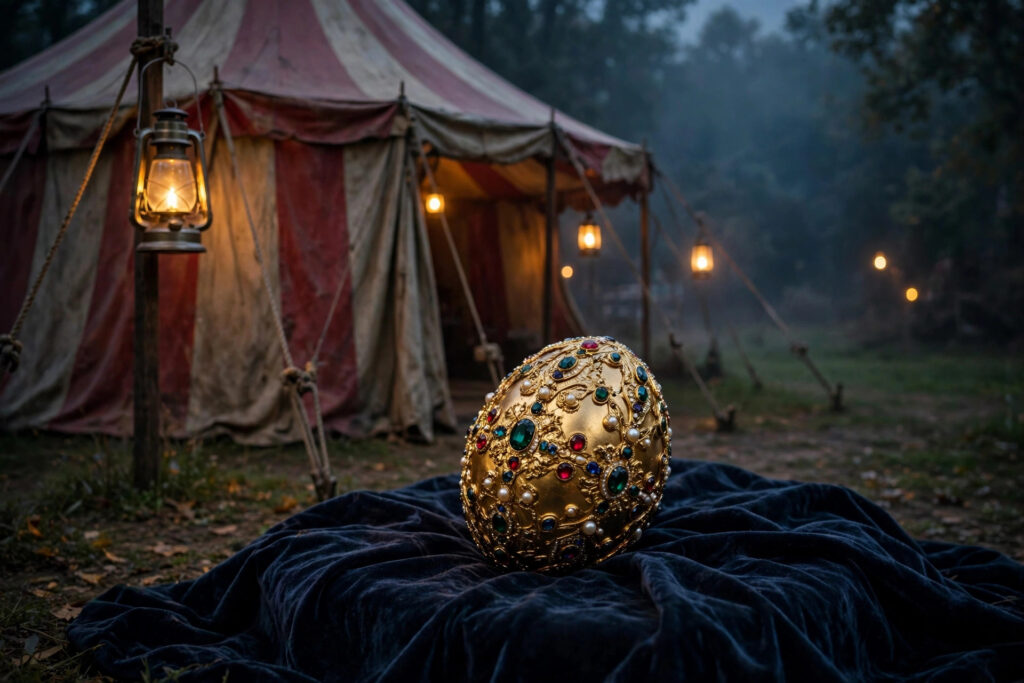
Everything in Octopussy starts with an egg. The film opens with British agent 009, dressed as a circus clown, staggering into the British ambassador’s residence in East Berlin and dying there, a fake Fabergé egg in his hand. He has been attacked by Mischka and Grishka, knife-throwing twin assassins who perform in Octopussy’s circus. The egg is a copy of a genuine Imperial Fabergé egg, one of the jewelled Easter eggs made for the Russian royal family, and its presence tells MI6 two things: somebody is forging priceless Russian treasures, and a British agent died finding out about it.
The real egg soon appears at an auction at Sotheby’s in London, and M sends Bond to identify the seller. Bond sits beside an antiquities expert, watches the bidding, and quietly swaps the real egg for the fake one 009 was carrying. Then he bids against the exiled Afghan prince Kamal Khan, driving the price up until Khan pays £500,000 for what he believes is the genuine article. It is a small, precise piece of tradecraft, and it is also a trap: Bond now knows Khan is the buyer, and Khan now knows somebody is playing games with his merchandise.
In the Octopussy ending explained here, the egg matters because it is the thread that pulls the whole conspiracy into view. Orlov has been looting the Kremlin art repository, taking genuine treasures and replacing them with forgeries so nobody notices. Khan pays him by smuggling the real pieces to the West, hidden inside Octopussy’s circus, where they are sold on for hard currency.
The egg is simply the one piece that goes wrong: 009 gets hold of a fake, the auction exposes the switch, and Bond follows the thread from London to India. Without the egg, Orlov’s plan would have stayed invisible until the bomb went off.
The auction scene itself comes from Ian Fleming. It is adapted from the short story “The Property of a Lady”, in which Bond attends an auction to identify a Soviet agent. The film keeps the trick — the switched egg, the bidding war — and builds an entire Cold War plot around it. The egg also carries Q’s contribution: when Bond later lets Khan’s associate Magda steal the real egg, it has been fitted with a listening and tracking device, so MI6 can hear everything Khan and Orlov say.

Who Is Octopussy, and What Does She Want?
Octopussy is the title character, and she is the most complicated figure in the film. Played by Maud Adams — who had already appeared in the series as Andrea Anders in The Man with the Golden Gun — she is a wealthy businesswoman, a jewel smuggler, and the leader of the Octopus Cult, an all-female group of smugglers and circus performers who live with her on a floating palace on Lake Pichola in Udaipur, India.
Her second-in-command is Magda, the ring leader of the circus, who wears a blue-ringed octopus tattoo as the mark of the cult.
The film never gives her first name. “Octopussy” is the childhood nickname her father gave her. Her father was Major Dexter-Smythe, a former British officer who stole a cache of gold and was tracked down by Bond years earlier. Bond was assigned to arrest him, but gave him twenty-four hours to settle his affairs before the arrest. Smythe chose to take his own life rather than face a court-martial.
Octopussy has waited years to meet the man who gave her father that choice, not for revenge, but to thank him for letting him die with honour instead of in disgrace.
That debt shapes everything she does, and it is the key to the Octopussy ending explained in this article. When Bond infiltrates her floating palace — arriving inside a fake crocodile that is really a small submarine built by Q — she welcomes him as a guest instead of killing him, even though Khan wants him dead.
She believes she is running a smuggling operation: her circus carries the real jewels west, the fakes go back to Moscow, and she, Khan and Orlov split the profits. She has no idea that Orlov has replaced the jewels with a bomb, and that her circus is being used to carry a nuclear weapon into an American base.
Her turn is the emotional centre of the Octopussy ending explained here. When Bond reaches the base in his clown disguise and tells her she has been betrayed, she does not hesitate.
She takes a gun, shoots the lock off the case that should hold her jewels, and finds the warhead. From that moment she is Bond’s ally, not his opponent, and her circus performers become his army. In the final act, it is her troops who storm Khan’s palace in India, and it is her decision — not Bond’s — that the smuggling ring is finished. The film’s title character is not a prize to be won. She is the person who decides how the story ends.
What Are Orlov and Kamal Khan Really Planning?
Orlov and Khan are partners, but they want different things, and that difference is what destroys them. Orlov is a Soviet general who believes the Warsaw Pact has a decisive advantage in conventional forces, and that détente is throwing that advantage away. In a Kremlin meeting early in the film, he argues for a massive attack on Western Europe, and General Gogol, the head of the KGB, overrules him in favour of disarmament. Orlov decides to get his war another way.
His plan is precise and cynical. A nuclear bomb will be detonated at a United States Air Force base in West Germany during a circus performance. Because the bomb will go off on an American base, and because it will look like an accident — a weapon going off during a show, with no warning and no launch — Europe will believe the Americans have detonated one of their own bombs by mistake.
The public outcry will force Western governments to give up their nuclear weapons unilaterally. With the nuclear threat removed, Orlov believes Soviet conventional forces can overrun Europe without resistance.
To pay for it, Orlov steals treasures from the Kremlin and replaces them with fakes. Khan smuggles the genuine pieces west through Octopussy’s circus and sells them. The money funds the operation, and the circus itself becomes the delivery system: the same troupe that carries the jewels will carry the bomb into the base, hidden among the equipment, while Octopussy believes she is still smuggling jewellery to Switzerland.
She is never told about the switch. In Orlov’s plan, she and her entire circus are meant to die in the blast, along with thousands of American airmen.
Khan’s interest, in the Octopussy ending explained here, is simpler: money and survival. He is an exiled Afghan prince living in luxury in India, running a counterfeiting business from his palace, and he wants the smuggling profits without the risk of a nuclear war.
When the plan starts to fall apart, he abandons Orlov without a second thought, flees to India, and tries to save himself and his fortune. Orlov, by contrast, believes in his plan to the end. He dies chasing the circus train across the East German border, shot dead by his own country’s border guards when he tries to follow it into the West. The film is unsentimental about both of them: the ideologue dies for his idea, and the opportunist dies running from his.
How Does Bond Get from the Circus Train to the Airbase?
The middle of the Octopussy ending explained here is a chase, and it is the part of the film that most viewers remember in pieces rather than in order.
After Bond learns from Q that Vijay, his MI6 contact in India, has been killed by Khan’s men, he follows the circus to Karl-Marx-Stadt in East Germany — the city now called Chemnitz — where it is scheduled to perform before crossing into West Germany. He also knows, by now, that the jewels have been replaced with something far worse, though he does not yet know exactly what.
Bond infiltrates the circus and discovers the warhead. Orlov, meanwhile, is trying to reach Khan and the train. Bond drives Orlov’s own car along the railway tracks and boards the moving circus train. Orlov gives chase on foot and tries to catch the train as it crosses the border, but East German border guards open fire and kill him. It is a deliberately unheroic death for a man who planned a war: no duel with Bond, no final speech, just a general shot down by his own side’s sentries while running after a train.
On the train, Bond settles the film’s oldest debt. He finds Mischka and Grishka, the knife-throwing twins who murdered agent 009 in the opening scene, and kills them both. It is the only revenge killing in the film, and it is done quietly, without ceremony, as a piece of the job.
Then Bond falls from the train. He hitch-hikes a lift from a passing motorist, steals a car from a nearby town, and drives for the airbase, racing a bomb he cannot see and a deadline he cannot check — the tensest stretch of the Octopussy ending explained in this article.

Why Does Bond Dress as a Clown?
The most famous image in Octopussy is Roger Moore in full clown make-up, and it is also the one most often misunderstood. Bond does not dress as a clown for a joke. He dresses as a clown because it is the only way into the base. The circus performers enter the American airbase in costume for their performance, and the guards are expecting clowns. A man in a dinner jacket would be stopped at the gate. A man in whiteface, with a red nose and a fright wig, walks straight in — and that is why the clown is the centrepiece of the Octopussy ending explained.
The disguise also completes a circle the film opened with. Agent 009 died dressed as a clown, carrying a fake egg. He had been working undercover on the smuggling ring, and the costume was his cover inside the circus. When Bond puts on the same disguise, he is finishing 009’s mission in 009’s clothes. The film does not underline the point, but it is there: the clown who died at the start of the story and the clown who saves the base at the end are doing the same job.
There is also a practical problem the disguise creates, and the film plays it straight. The West German police are chasing Bond, the base guards do not believe a word he says, and for several minutes he cannot convince anyone that the bomb is real. He has to find Octopussy and Magda inside the performance and persuade them, in costume, in front of an audience, that they have been betrayed. The scene works because the disguise that gets him in is the same disguise that makes him unbelievable.
When Octopussy finally believes him, she shoots the lock off the jewellery case herself, and the bomb is revealed to everyone at once.
How Is the Bomb Defused?
The defusing is the quietest scene in the Octopussy ending explained here, and it is deliberately so. There is no countdown clock filling the screen, no last-second wire pulled in slow motion, and no speech about how the device works. Bond finds the warhead hidden in the case that was supposed to hold the smuggled jewels, follows the wiring, and works on it while the circus performance goes on around him and the audience applauds, unaware that the finale they are watching is a nuclear detonation.
What makes the scene work is that Bond does not do it alone. Octopussy, who has just learned that her circus was carrying a bomb and that she and her performers were meant to die in the blast, helps him. Magda, her second-in-command, helps too. The three of them — a British agent, a jewel smuggler and a circus ringmistress — defuse a Soviet nuclear weapon together, in a tent, while a band plays. It is the film’s best idea: the people Orlov planned to sacrifice are the people who stop his bomb.
The bomb is defused with the countdown in its final seconds, and that quiet finish is the point of the Octopussy ending explained in this guide. The film does not give the audience a number to count down from, and that restraint is the point.
The tension comes not from a timer but from the knowledge that the blast would have been blamed on the Americans, and that Europe would have disarmed on a lie. When the device goes dead, the war Orlov wanted dies with it. There is no explosion, no mushroom cloud, no heroic last line. The bomb simply stops, and the show goes on.

What Happens on Khan’s Plane?
With the bomb defused, the Octopussy ending explained here moves to its last set piece: Khan has lost everything except his money and his life, and he intends to keep both. He has already returned to his palace in India and is preparing to flee when Octopussy’s circus performers, furious at his betrayal, storm the grounds. Octopussy herself tries to kill him, but Gobinda, Khan’s huge bodyguard, overpowers her and drags her aboard Khan’s private plane as a hostage. Khan and Gobinda take off, believing they have escaped.
Bond arrives at the palace just as they leave, and what follows is the film’s final action sequence. Bond chases the plane, climbs onto its fuselage while it is in the air, and fights Gobinda on the outside of the aircraft. Gobinda, who has spent the whole film as Khan’s silent, unstoppable enforcer, loses his footing and falls to his death.
Bond disables an engine and the elevator panel, and the plane begins to fall. He pulls Octopussy clear, and the two of them jump from the aircraft onto a nearby cliff seconds before it crashes into the mountainside and explodes, killing Khan. It is a deliberately modest piece of spectacle by Bond standards: no gadgets, no one-liner, just two people jumping off a dying plane. The man who paid for the conspiracy dies in it, and the woman he betrayed walks away from the wreckage on foot.
How Does Octopussy End?
The film closes the way most Roger Moore films close, but with a difference that matters. Bond recuperates with Octopussy aboard her private galley in India, the two of them together after everything they have survived. In the film’s final scene, the Minister of Defence and General Gogol discuss the return of the stolen jewels to the Kremlin, a quiet bureaucratic ending to a story that nearly started a war. Then the screen promises that James Bond will return in A View to a Kill.
What is unusual about the Octopussy ending explained here is who is left standing. In most Bond films, the villain’s organisation is destroyed and the Bond girl leaves with Bond. Here, Octopussy’s organisation survives — her circus, her people, her floating palace — because she was never really the villain.
She was a smuggler who was used as a courier for a bomb, and the film lets her keep her world. Bond does not arrest her, reform her, or take her away from India. He stays with her, on her boat, in her world. For a series that usually ends with Bond flying home, it is a rare, generous ending.
The fates of the main characters are clean. Orlov is dead, shot by border guards. Khan is dead, killed in the plane crash. Gobinda is dead, fallen from the plane. Mischka and Grishka are dead, killed by Bond on the train. Vijay is dead, murdered by Khan’s men in India, and his death is the one the film treats as a genuine loss — a friendly, funny ally killed off-screen while doing his job.
Octopussy, Magda and the circus survive. The jewels go back to Moscow. And Bond, who started the film chasing a fake egg, ends it with the real thing: a woman who chose to help him, and a war that never happened.
Octopussy Ending vs the Fleming Stories
The Octopussy ending explained above is almost entirely original to the film. The title comes from Ian Fleming’s short story collection “Octopussy and The Living Daylights”, published in 1966, but the short story “Octopussy” is a small, quiet piece of work. In it, Bond visits Major Dexter Smythe in Jamaica, a former officer who stole gold and murdered his guide, and gives him a choice between arrest and suicide. Smythe, who keeps a pet octopus he calls Octopussy, dies when a scorpion fish stings him and the octopus drags him underwater — a death Bond records as an accident but judges a suicide.
There is no circus, no bomb, no Khan and no Orlov. The film takes the story’s backstory — Smythe, the gold, the octopus — and gives it to the title character as her family history.
The auction scene comes from a second Fleming story, “The Property of a Lady”, in which Bond attends a Sotheby’s sale to identify a Soviet agent. The film keeps the setting and the trick, and nothing else. Even Khan’s reaction after losing the backgammon game is borrowed from Fleming’s novel Moonraker, not from any Octopussy story. The film’s screenplay, by George MacDonald Fraser, Richard Maibaum and Michael G. Wilson, is an original Cold War thriller wearing a Fleming title.
That is worth knowing because it explains the shape of the Octopussy ending explained above. Fleming’s Bond stories usually end with a single villain defeated and a single truth revealed. Octopussy ends with two villains dead in two different ways — Orlov shot by his own side, Khan killed in his own plane — and with the supposed villain of the piece, Octopussy herself, revealed as a victim of the plot rather than its author.
The film’s ending is not a Fleming ending. It is a Hollywood ending built on a Fleming name, and it works because the film is honest about what it is: a big, colourful adventure about a bomb that never goes off.
The film also belongs to its moment. It was made when the Cold War was at one of its coldest points, and Orlov’s plan — a fake accident that tricks the West into disarming — plays directly on the fears of the early 1980s, when nuclear weapons and disarmament marches were on the news every night.
The theme song, “All Time High”, performed by Rita Coolidge with music by John Barry, is one of the softest in the series, and it sits oddly against a plot about nuclear war. That contrast is the film in miniature: a gentle song, a garish circus, and a bomb underneath it all.
Octopussy Ending Timeline: The Facts
Here is the Octopussy ending explained against the real dates, so the film’s story and its production stay separate.
- 1966: Ian Fleming’s short story collection “Octopussy and The Living Daylights” is published after his death. The story “Octopussy” gives the film its title character’s backstory; “The Property of a Lady” gives it the auction scene.
- 1981: Roger Moore tells the producers he wants to retire after For Your Eyes Only. The search for a new Bond includes screen tests for James Brolin, Michael Billington and Oliver Tobias.
- 1982: the rival Bond film Never Say Never Again is announced, with Sean Connery returning as 007. Moore agrees to return for Octopussy, his sixth film in the role.
- 6 June 1983: Octopussy is released in the UK; it opens in the US on 10 June 1983. It is the first Bond film released by MGM, which had absorbed United Artists.
- 1983: the film earns $187.5 million worldwide on a $27.5 million budget. Four months later, Never Say Never Again opens, and Moore’s Bond wins the box-office contest.
- In the story: 009 dies as a clown in East Berlin; Bond swaps the egg at Sotheby’s and forces Khan to pay £500,000 for a fake; Bond meets Octopussy in Udaipur; Orlov’s bomb is hidden in the circus; Orlov is shot at the border; Bond kills Mischka and Grishka on the train; Bond defuses the bomb in his clown disguise; Khan flees to India; Gobinda falls from the plane; Khan dies in the crash; Bond recuperates with Octopussy.
- 1985: A View to a Kill follows, the next film in the series and Roger Moore’s seventh and final outing as James Bond.
Our Take
The Octopussy ending explained as a piece of filmmaking is a strange, likeable mess that works better than it has any right to. The plot is overcomplicated — a jewel-smuggling circus carrying a nuclear bomb is the kind of idea that only survives because the film commits to it completely — but the ending earns its keep. The bomb is stopped not by a gadget or a gunfight, but by a smuggler opening a case she believed held her own property and finding a warhead instead. That is a good scene, and it is the scene the whole film is building toward.
The film’s real subject is trust, and the ending is where that subject pays off. Octopussy trusts Khan, and he betrays her. Orlov trusts Khan, and he is abandoned. Khan trusts his money to save him, and it does not.
The only trust that holds is the one between Bond and Octopussy, two people with every reason to hate each other — he gave her father the choice that led to his death — who decide, instead, to believe each other. When she shoots the lock off the bomb case, she is not following Bond’s orders. She is choosing to trust him over the man she has done business with for years.
If there is a flaw, it is the one the film invites you to notice: the clown disguise, the crocodile submarine, the plane fight on the fuselage — Octopussy is the silliest of the Moore films, and the silliness sits awkwardly next to a plot about nuclear disarmament. But that awkwardness is also the film’s charm. It is a Bond film that knows exactly how ridiculous it is, and it never apologises for it. The bomb never goes off, the circus survives, and Bond ends the film on a boat in India with a woman who outsmarted everyone except the two men who tried to kill her.
For readers who came here for the Octopussy ending explained in brief, the short version is this: the smuggler was never the villain, the bomb was never meant for the people carrying it, and the man in the clown suit was the only person telling the truth.
Watch it again with the twist in mind, and the whole film changes shape. Every scene where Khan plays the gracious host becomes a scene where a thief is counting his money, and every scene where Octopussy looks like a villain becomes a scene where a businesswoman is being used. That is the mark of a plot that respects its audience, and it is why Octopussy, for all its chaos, remains one of the most rewatchable of the Moore films.
Read Also:
Read Also: James Bond Movies: The Complete 007 Film Guide (1962–2026)
Read Also: For Your Eyes Only Ending Explained: Kristatos, the ATAC and Bond’s Choice
Read Also: Moonraker Ending Explained: Drax, the Space Station and Jaws’ Choice
For the full film story, see Wikipedia’s Octopussy (1983) page, and for the official home of 007, see 007.com.
Still curious? Here is the Octopussy ending explained in five quick answers.
Frequently Asked Questions
How does Octopussy end?
Bond defuses the nuclear bomb at the US Air Force base, then follows Khan to India. Octopussy’s troops storm Khan’s palace, Gobinda kidnaps Octopussy and flees with her in Khan’s plane, and Bond fights Gobinda on the fuselage before he and Octopussy jump to safety seconds before the plane crashes, killing Khan.
What was General Orlov’s plan in Octopussy?
Orlov planned to detonate a nuclear bomb at a US Air Force base in West Germany during a circus performance. The blast would look like an accidental American detonation, so Europe would demand nuclear disarmament, leaving the continent open to a Soviet invasion.
Why does Bond dress as a clown at the end of Octopussy?
The circus performers enter the airbase in costume, so a clown disguise is Bond’s only way inside without being stopped. It also mirrors the opening of the film, when agent 009 dies dressed as a clown while carrying a fake Fabergé egg.
Who is Octopussy, and why does she help Bond?
Octopussy is a wealthy jewel smuggler and circus owner, and the daughter of Major Dexter-Smythe, the officer Bond once allowed to take his own life instead of facing trial. She thanks Bond for that mercy, and she turns against Khan and Orlov when she learns they planted a bomb in her circus without telling her.
Does Octopussy die at the end of Octopussy?
No. Octopussy survives. Bond rescues her from Khan’s plane, and the film closes with Bond recuperating with her aboard her private galley in India while the Minister of Defence and General Gogol discuss returning the stolen jewels to the Kremlin.
Kunal Chaudhary is the founder and editor of Media1Gyan, covering Bond 26 casting news, rankings and Bond history since July 2026, sourcing every developing story from trade reporting and official announcements and labelling rumor separately from confirmed fact. Kunal is the founder and editor of Media1Gyan.com, an independent James Bond 007 fan blog. A lifelong James Bond fan, he started Media1Gyan to give fellow fans clear, well-researched coverage of the world of 007 — from the classic Eon films to the new Amazon-MGM era and the road to Bond 26. On Media1Gyan, Kunal covers Bond movie news and casting rumors, ranked listicles (villains, Bond girls, theme songs, gadgets), explainers on Bond history and trivia, and deep dives into characters like Vesper Lynd and Ernst Stavro Blofeld. Every article is researched from publicly available information and reliable sources, and reviewed for accuracy before publishing. His approach is fan-first: no hype without sourcing, no rumors presented as fact, and complex Bond lore explained in plain language. When he covers developing stories like the next James Bond casting, articles are updated as new information breaks. Follow Media1Gyan.com for daily James Bond coverage — news, rankings, and guides for fans around the world. He writes under his real name.