
Short Answer
Spectre ending explained in one line: Bond discovers that Franz Oberhauser, his childhood foster brother, is Ernst Stavro Blofeld, the head of the criminal organisation SPECTRE and the man behind every tragedy of the Daniel Craig era. Bond stops the Nine Eyes surveillance programme, rescues Madeleine Swann from the rigged ruins of the old MI6 building, shoots down Blofeld’s helicopter on Westminster Bridge — and then, with Blofeld helpless at gunpoint, refuses to kill him.
He leaves Blofeld to be arrested, takes Madeleine’s hand, and drives away in his restored Aston Martin DB5. That is the spectre ending explained in short: the first Bond film in which 007 wins by walking away from revenge.
It is the most argued-over ending of the Daniel Craig era, and the confusion is understandable. Spectre (2015) ties together four films’ worth of villains, reveals that Bond’s enemy is his own foster brother, and then ends not with a death but with a mercy. This article is the full spectre ending explained, beat by beat: what happens in the finale, who Franz Oberhauser really is, what Nine Eyes was, why Bond spares Blofeld, and how the ending sets up No Time to Die.
What Happens at the End of Spectre?
The spectre ending explained beat by beat starts in the Moroccan desert. Bond and Madeleine Swann have been taken to Blofeld’s hidden base, built inside a meteor crater. Blofeld straps Bond to a chair and drills into his skull, telling him that he is the author of all Bond’s pain — the man behind the deaths of Vesper Lynd and M, and every disaster of Bond’s recent life. Madeleine tells Bond she loves him, and in the chaos Bond sets off the explosive watch Q gave him. Madeleine throws it at Blofeld, it detonates in his face, and the two escape as the base burns.
Back in London, the second half of the ending plays out. C, the head of the new Centre for National Security, is about to switch on Nine Eyes, a global surveillance system that would end the 00 programme and hand the world’s intelligence to SPECTRE. M, Q and Moneypenny work from the shadows to stop it, and M confronts C in his office. In the struggle, C falls to his death. The programme never goes live.

Blofeld, scarred over his right eye from the watch explosion, lures Bond to the ruins of the old MI6 building, which is scheduled for demolition after Silva’s bombing in Skyfall. He tells Bond that Madeleine is hidden inside and that explosives will go off in three minutes. Bond finds her, bound and gagged, and the two escape by boat as the building collapses behind them.
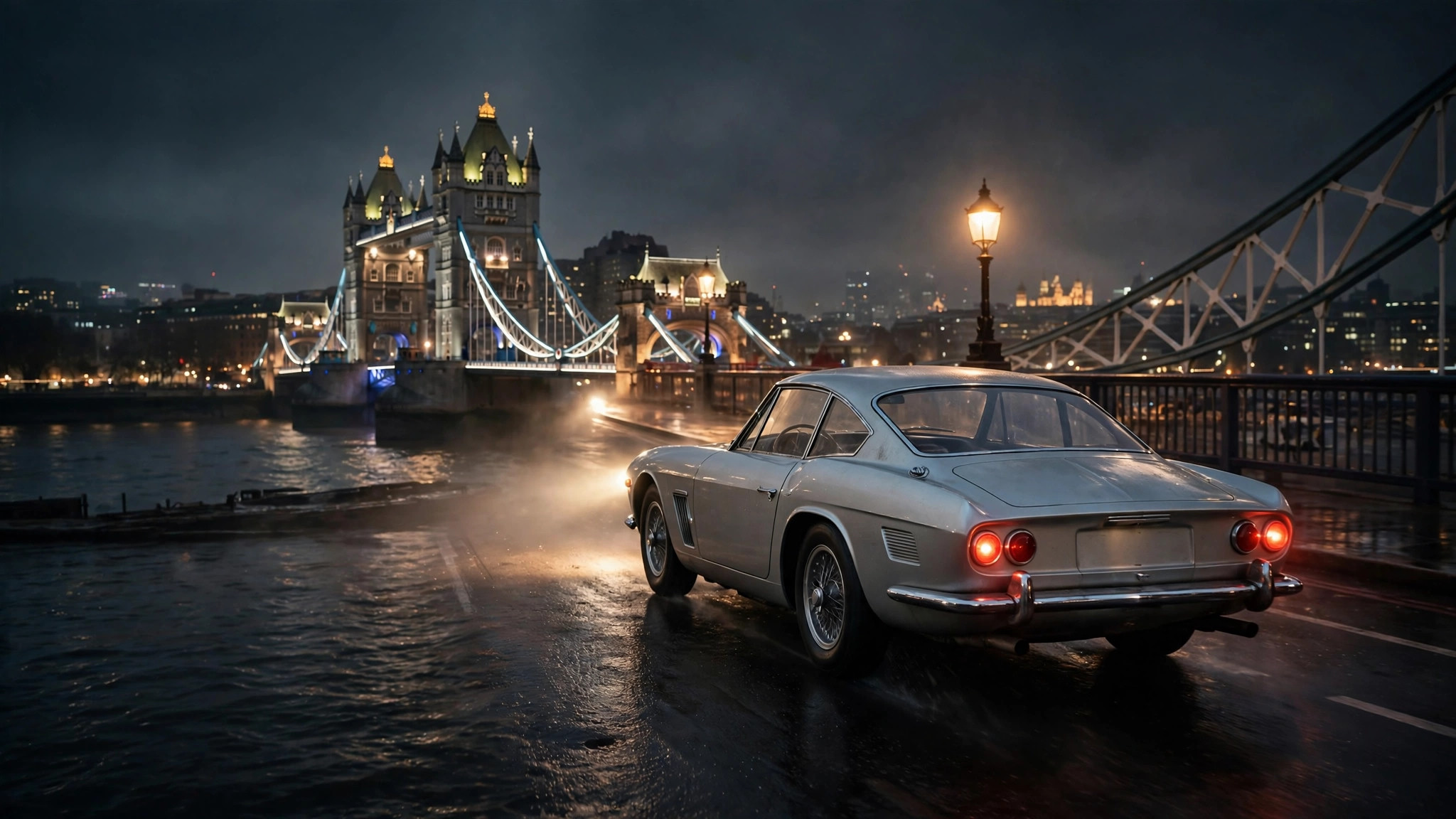
Blofeld flees by helicopter. Bond shoots it down, and it crashes onto Westminster Bridge. Blofeld crawls from the wreckage, and Bond stands over him with a gun. Blofeld dares him to finish it. Bond lowers the weapon and walks away, leaving Blofeld to be arrested by M. Then Q returns Bond’s rebuilt Aston Martin DB5, and Bond drives away with Madeleine as the credits promise that James Bond will return.
Spectre Ending Explained: Who Is Franz Oberhauser?
That reveal is the heart of the spectre ending explained, and it is the part most viewers miss on a first watch. Franz Oberhauser is not a stranger. After Bond’s parents died, he was taken in by Hannes Oberhauser, a mountaineering instructor who became his legal guardian. Franz was Hannes’s son, and he grew to hate the attention his father gave the orphaned Bond. Franz killed his own father, faked his own death in an avalanche, and reinvented himself as Ernst Stavro Blofeld, building SPECTRE into a global criminal empire with one purpose: to make Bond suffer.
The film plants this reveal from the opening scene. The Mexico City mission begins with a message from the previous M, sent after her death, telling Bond to kill Marco Sciarra and attend his funeral. The ring Bond takes from Sciarra’s finger bears the octopus symbol of SPECTRE, and it leads him to the organisation’s meeting in Rome, where Oberhauser is revealed as its leader.
Every step of the film is Blofeld pulling Bond towards him, because the whole plot is personal. The terrorist attacks, the surveillance programme, the kidnapping of Madeleine — all of it is designed to bring Bond to the desert so Blofeld can tell him, face to face, that he wrote his life’s tragedies.
Whether Blofeld really caused all of it is a fair question. The film presents his claim at face value: he says he is behind Vesper’s death, M’s death, and the rest. But the earlier films were written before this reveal existed, so the connection is a retcon — a later film rewriting the meaning of earlier ones. The spectre ending explained honestly has to admit this.
In the story, Blofeld is the puppet master of the Craig era. In reality, the filmmakers connected the dots backwards, and the seams show if you look closely. What matters for the ending is that Bond believes enough of it to want revenge — and then refuses it.
What Is Nine Eyes?
The Nine Eyes plot is the second half of the spectre ending explained, and it is the part that feels most like a modern thriller. Nine Eyes is a global surveillance system that would link the intelligence agencies of nine countries into one network, sharing everything and watching everyone. It is proposed by Max Denbigh, known as C, the new head of the Centre for National Security, who argues that spies like Bond are obsolete and that surveillance can replace them. If Nine Eyes goes live, the 00 programme is shut down and MI6 is folded into C’s new centre.
The twist is that C is working with Blofeld. SPECTRE has been staging terrorist attacks around the world to create the fear that makes Nine Eyes seem necessary, and in return C feeds SPECTRE the intelligence it needs to stay ahead of every investigation. Nine Eyes would not just end Bond’s job. It would give a criminal organisation access to the surveillance of nine governments at once.
The plot is stopped the old-fashioned way. While Bond is in the desert, M, Q and Moneypenny work against the clock in London. Q hacks the system from a hotel room, Moneypenny runs interference, and M confronts C directly. C falls to his death during the struggle, and Nine Eyes never switches on. The film’s message is plain: a world watched by machines is a world controlled by whoever owns the machines, and the only defence is people willing to break the rules to stop it.
How SPECTRE Connects the Craig-Era Villains
One scene in the middle of the film does the heavy lifting for the whole spectre ending explained. When Q analyses the data hidden in Sciarra’s ring, he finds that SPECTRE bankrolled Quantum and stood behind the villains of the three previous films. The connection is laid out plainly, and it reframes the entire Craig era as one long story rather than four separate adventures:
| Film | Villain | SPECTRE connection revealed |
|---|---|---|
| Casino Royale (2006) | Le Chiffre | Financed by SPECTRE; his failure is why the organisation later targets Bond |
| Quantum of Solace (2008) | Dominic Greene | A Quantum operative; Quantum itself was a SPECTRE subsidiary |
| Skyfall (2012) | Raoul Silva | A former MI6 agent whose attack on M served SPECTRE’s war on the 00 programme |
| Spectre (2015) | Ernst Stavro Blofeld | The head of SPECTRE himself, and Bond’s foster brother |
The table is the film’s big idea, and it is also its biggest gamble. It turns four standalone films into a single saga with one villain at the centre, which gives the Craig era a shape no earlier Bond era had.
But it also means the earlier villains, written as independent threats, are now reduced to employees. Le Chiffre, Greene and Silva were frightening because they seemed to act on their own ambitions. As SPECTRE agents, they become middle management. That trade-off — a bigger story at the cost of smaller villains — is the central debate about Spectre, and it is still going on a decade later.

Why Does Bond Spare Blofeld?
The most important moment of the spectre ending explained is also its quietest. Bond has Blofeld at gunpoint on Westminster Bridge. Blofeld is injured, unarmed, and daring him to shoot. Every Bond film before this one ends with the villain dead. Bond lowers the gun and walks away.
He does it for two reasons, and the film gives you both. The first is Madeleine. Blofeld’s whole plan was to prove that Bond is nothing but a killer — a man who destroys everything he touches. If Bond shoots an unarmed man in cold blood, Blofeld wins the argument. Sparing him is Bond proving that he is more than the weapon SPECTRE made him.
The second reason is the Craig era itself. This Bond has been running on revenge since Casino Royale, and every act of vengeance has cost him someone he loved. Vesper, M, and nearly Madeleine. Walking away is the first time this Bond breaks the cycle instead of repeating it.
There is also a practical reason, and the film is honest about it. Blofeld alive is more useful than Blofeld dead. Arrested, he can be interrogated, and his network can be dismantled. Dead, he becomes a martyr with secrets no one can recover.
M arrests him on the bridge, and the film treats that as the victory — the law, not the gun, finishing the job. It is the same choice No Time to Die later reverses, when Blofeld is killed in prison, but in Spectre the mercy is the point. Bond does not just defeat his enemy. He refuses to become him.
Spectre Ending Explained: 7 Questions Answered
Here is the spectre ending explained in seven answers, covering the questions viewers ask most after the credits roll:
- Does Bond kill Blofeld at the end of Spectre? No. Bond shoots down Blofeld’s helicopter, then stands over the injured Blofeld with a gun and refuses to shoot. M arrests Blofeld on Westminster Bridge, and he is taken into custody alive.
- Who is Franz Oberhauser? Franz Oberhauser is Bond’s childhood foster brother. His father, Hannes Oberhauser, was Bond’s legal guardian after Bond’s parents died. Franz killed his father, faked his own death in an avalanche, and became Ernst Stavro Blofeld.
- What is Nine Eyes? A surveillance system linking nine countries’ intelligence agencies, proposed by C to replace human agents like Bond. It is secretly a SPECTRE operation: the organisation staged terror attacks to create demand for it, and C fed it intelligence in return.
- How does Bond escape the brain drill? Blofeld tortures Bond with a drill designed to destroy his memory, but Madeleine tells Bond she loves him, and Bond uses the distraction to trigger the explosive watch Q gave him. Madeleine throws the watch at Blofeld, and the blast lets them escape.
- What happens to Madeleine Swann? Bond rescues her from the rigged MI6 building, and the two drive away together in the restored Aston Martin DB5. She returns in No Time to Die, where the film picks up five years later with the couple on holiday in Italy — and with a daughter, Mathilde, whose existence Bond does not yet know.
- What happens to Mr White? Mr White, Madeleine’s father and a former Quantum operative, is dying of thallium poisoning when Bond finds him in Austria. He asks Bond to protect his daughter, and then takes his own life after Bond promises he will.
- Does Spectre set up No Time to Die? Yes, directly. Blofeld survives in prison and continues to haunt Bond from his cell, Madeleine’s secret about her past drives the sequel’s plot, and the film ends with Bond having retired from MI6 — the starting point for the five-year gap before No Time to Die begins.
How the Ending Sets Up No Time to Die
The spectre ending explained is incomplete without the sequel, because Spectre ends with a door left deliberately open. Bond has left MI6 and driven away with Madeleine, but Blofeld is alive in prison, and Madeleine is keeping a secret about her past that she has not told Bond.
No Time to Die opens five years later with the couple on holiday in Matera, Italy, and the first thing that happens is an ambush that shatters their peace. Madeleine’s secret — her connection to Lyutsifer Safin, the man who once saved her life as a child — becomes the engine of the sequel.
Blofeld’s survival matters too. In No Time to Die he is still pulling strings from his cell, and his death in prison is the event that finally closes the Craig era’s central rivalry. Spectre chose to keep him alive so the story could continue; the sequel chose to end him so it could finish. The two choices belong together. Spectre is the film where Bond learns he can walk away from revenge. No Time to Die is the film where he learns what that choice costs, when the man he spared keeps hurting the people he loves.
The five-year gap is also doing quiet work. When Spectre ends, Bond and Madeleine are in love and free. When No Time to Die begins, they have been apart for five years, and Bond does not know he has a daughter. The ending of Spectre is happy; the beginning of the sequel shows how fragile that happiness was.
That is why the ending still divides fans. It promises a happy ending the next film takes away, and whether that feels like a betrayal or a brave choice depends on which film you watch last.
Our Take
The spectre ending explained comes down to one image: Bond lowering his gun. Everything else — the desert base, the brain drill, the exploding watch, the helicopter on Westminster Bridge — is spectacle. The gun is the argument.
For four films, Daniel Craig’s Bond has been a man who solves problems by killing the people who cause them, and the films have shown, again and again, what that costs. Spectre is the first one that lets him stop. He does not forgive Blofeld, and he does not forget what Blofeld did. He simply refuses to let revenge be the last word, and that refusal is the most grown-up thing this Bond ever does.
It is also, honestly, a flawed ending. The brother reveal is soap opera dressed as espionage, the Nine Eyes plot is resolved off-screen by supporting characters while Bond is elsewhere, and the retcon that makes Blofeld responsible for everything shrinks the earlier films rather than enlarging them.
The ending works emotionally and wobbles logically, which is a fair description of Spectre as a whole. But the final shot earns its place. Bond driving away in the DB5 with Madeleine, having chosen life over vengeance, is the happiest ending any Bond film had delivered in decades — and the fact that the next film took it away only makes this one more precious. Spectre ends with Bond free. That was worth celebrating, even if it did not last.
Frequently Asked Questions
What happens at the end of Spectre?
The spectre ending explained in short: Bond stops the Nine Eyes surveillance programme, rescues Madeleine Swann from the rigged old MI6 building, shoots down Blofeld’s helicopter on Westminster Bridge, and spares Blofeld’s life, leaving him to be arrested. He then drives away with Madeleine in his restored Aston Martin DB5.
Is Franz Oberhauser really Blofeld?
Yes. Franz Oberhauser is Bond’s childhood foster brother. His father Hannes was Bond’s legal guardian, and Franz killed him, faked his own death in an avalanche, and took the name Ernst Stavro Blofeld. The reveal makes the villain of Spectre the most personal enemy Bond has ever faced.
What is Nine Eyes in Spectre?
Nine Eyes is a global surveillance system linking nine countries’ intelligence agencies, proposed by C to replace agents like Bond. It is secretly a SPECTRE scheme: the organisation staged terror attacks to create demand for it, while C fed it intelligence. M stops it by confronting C, who falls to his death, and the programme never goes live.
Why did Bond not kill Blofeld?
Bond spares Blofeld because killing an unarmed man would prove Blofeld’s claim that Bond is nothing but a killer. Sparing him breaks the cycle of revenge that has defined the Craig era, and it leaves Blofeld alive to be arrested and interrogated. The mercy is the point of the ending, and it is what lets Bond walk away with Madeleine.
How does Spectre connect to No Time to Die?
The spectre ending explained sets up the sequel directly: Blofeld survives in prison, Madeleine keeps a secret about her past, and Bond has left MI6. No Time to Die picks up five years later with Bond and Madeleine on holiday in Italy, and Madeleine’s secret and Blofeld’s imprisonment drive the sequel’s plot.
Read Also:
Read Also:
James Bond Movies: The Complete 007 Film Guide (1962–2026)
Skyfall Ending Explained: M’s Death, Silva’s Revenge and the Reset
For the full production history and plot details, see Wikipedia on Spectre (2015 film), and for a scene-by-scene recap of how the film leads into No Time to Die, see RadioTimes on the Spectre recap.
So that is the spectre ending explained: a foster brother turned villain, a surveillance state stopped by a handful of loyal people, and a hero who finally puts his gun down. Bond drives away with Madeleine in the DB5, and for one film, the man who has lost everyone gets to keep the person he loves. The next film would take that away. But in Spectre, the ending belongs to Bond — and to the choice he makes on Westminster Bridge.

Kunal Chaudhary is the founder and editor of Media1Gyan, covering Bond 26 casting news, rankings and Bond history since July 2026, sourcing every developing story from trade reporting and official announcements and labelling rumor separately from confirmed fact. Kunal is the founder and editor of Media1Gyan.com, an independent James Bond 007 fan blog. A lifelong James Bond fan, he started Media1Gyan to give fellow fans clear, well-researched coverage of the world of 007 — from the classic Eon films to the new Amazon-MGM era and the road to Bond 26. On Media1Gyan, Kunal covers Bond movie news and casting rumors, ranked listicles (villains, Bond girls, theme songs, gadgets), explainers on Bond history and trivia, and deep dives into characters like Vesper Lynd and Ernst Stavro Blofeld. Every article is researched from publicly available information and reliable sources, and reviewed for accuracy before publishing. His approach is fan-first: no hype without sourcing, no rumors presented as fact, and complex Bond lore explained in plain language. When he covers developing stories like the next James Bond casting, articles are updated as new information breaks. Follow Media1Gyan.com for daily James Bond coverage — news, rankings, and guides for fans around the world. He writes under his real name.