The Short Answer
Thunderball ending explained in one line: Bond stops SPECTRE from detonating a stolen atomic bomb over Miami, and it is Domino Derval — not Bond — who kills the villain Emilio Largo, shooting him with a spear gun aboard his yacht the Disco Volante as he is about to shoot Bond. The yacht then crashes into the rocks and explodes, Bond and Domino leap into the sea, and a passing aircraft lifts them out of the water with a skyhook.
That is the thunderball ending explained in short: the girl avenges her murdered brother, the bomb never reaches Miami, and the biggest Bond film of the 1960s ends with a rescue from the sky.
Thunderball (1965) is the fourth James Bond film, the first shot in widescreen Panavision, the first to run over two hours, and the biggest box-office hit the series had seen up to that point. It is also the Bond film with the strangest ending — not because the plot is complicated, but because the hero does not land the killing blow.
This article is the full thunderball ending explained, beat by beat: what SPECTRE stole and why, how Bond finds the bombs, what happens in the giant underwater battle, why Domino kills Largo, how the skyhook rescue works, and how Ian Fleming’s novel ends differently.
The Story So Far: SPECTRE’s £100 Million Ransom
To understand the thunderball ending explained, you first need the theft. SPECTRE’s Number Two, Emilio Largo — played by Adolfo Celi, the eye-patch-wearing villain with the most relaxed menace in the series — has a plan that makes Goldfinger’s Fort Knox scheme look small.
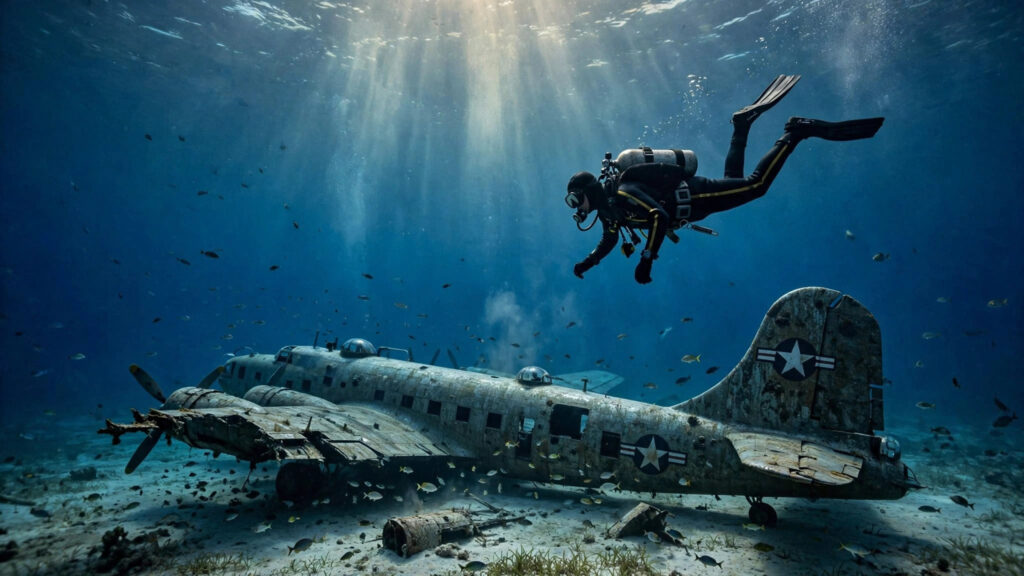
His men murder NATO pilot François Derval and replace him with a lookalike, Angelo Palazzi, who flies a Royal Air Force Avro Vulcan bomber on a training exercise, kills the rest of the crew, and ditches the aircraft in the shallow sea off the Bahamas. Largo’s divers recover the bomber’s two atomic bombs and hide them underwater.
Then SPECTRE sends its demand to NATO: pay £100 million in diamonds within seven days, or a major city in the United Kingdom or the United States will be destroyed. The film never names the target at first. That is deliberate. The threat works precisely because nobody knows which city is in danger — and the thunderball ending explained only makes sense once you know the answer is Miami.
All 00 agents are put on high alert in an emergency briefing in London, and the operation is given its codename: Operation Thunderball. Bond is sent to Nassau in the Bahamas, because that is where the Vulcan went down.
Before he leaves, he has already crossed paths with the plot at Shrublands, a health clinic M sent him to after a poor medical report. There he spots Count Lippe, a SPECTRE man, and Angelo Palazzi — the pilot who will steal the bomber. Lippe tries to kill Bond on a spinal traction machine; Bond survives, and Lippe is later killed by SPECTRE assassin Fiona Volpe, who fires a rocket from her motorcycle into his car. The film is telling you early that SPECTRE cleans up its own loose ends — a habit that will matter at the end.
Thunderball Ending Explained: The Final Battle

The thunderball ending explained begins underwater, and it stays there for a long time. Bond has worked out that Largo is behind the theft. He has met Domino Derval — played by Claudine Auger — Largo’s mistress, and told her the truth: her brother François was the murdered pilot, and Largo ordered it.
Domino agrees to help. She boards the Disco Volante, Largo’s yacht, carrying a Geiger counter disguised as a camera, and confirms the yacht has been used to transport the bombs. Largo discovers her and has her tortured for information.
Meanwhile Bond, diving on the sunken Vulcan with Felix Leiter — played by Rik Van Nutter — finds the first bomb still in the wreck, along with Angelo’s body. Largo has already moved the second bomb aboard the Disco Volante, and it is on its way to its target. Bond now knows both halves of the plan: one bomb recovered, one bomb still in play, and a deadline running out.
The final battle is the largest underwater fight ever filmed at that point, and about a quarter of the whole film takes place underwater. Bond leads a team of United States Navy frogmen against Largo’s divers in the waters around the Disco Volante. It is a slow, silent, brutal fight — harpoons, knives, and underwater explosives, with men moving in heavy diving gear through the blue gloom.
The Navy team wins. Largo’s men are killed or scattered. But the bomb is not in the water any more. It is on the yacht, and Largo is taking it to Miami.
How Domino Kills Largo
The most surprising part of the thunderball ending explained is who kills the villain. Bond boards the Disco Volante and fights his way to Largo, but he is outmatched. Largo is bigger, stronger, and armed — and he has Bond cornered. He is about to shoot Bond when Domino, who has escaped from her bonds below deck, appears behind him and fires a spear gun into his back.
It is the single most important shot in the film, and it is not fired by James Bond. Domino kills Largo for a reason the film has been building since the middle act: Largo murdered her brother François, used her as decoration on his yacht, and tortured her when she turned against him. Her revenge is personal, not professional. She does not hesitate, and she does not miss.
Largo falls dead, and the man who held the world to ransom for £100 million is killed by the woman he treated as property.
This is also why the thunderball ending explained keeps being discussed sixty years later. In most Bond films, the hero kills the villain and gets the girl. Here the girl kills the villain and saves the hero.
Bond’s job in the climax is to survive long enough for Domino to act — and to make sure the bomb never reaches Miami. That is the beat the whole thunderball ending explained turns on: the villain is not beaten by a gadget or a gunfight, but by the woman he wronged.
The Skyhook Rescue
With Largo dead, the Disco Volante is out of control. Its hydrofoil section detaches, the yacht runs aground on the rocks, and it explodes — taking the second bomb and Largo’s whole operation with it. Bond and Domino jump into the sea just before the explosion, and for a moment it looks as if they will be left drifting in open water.
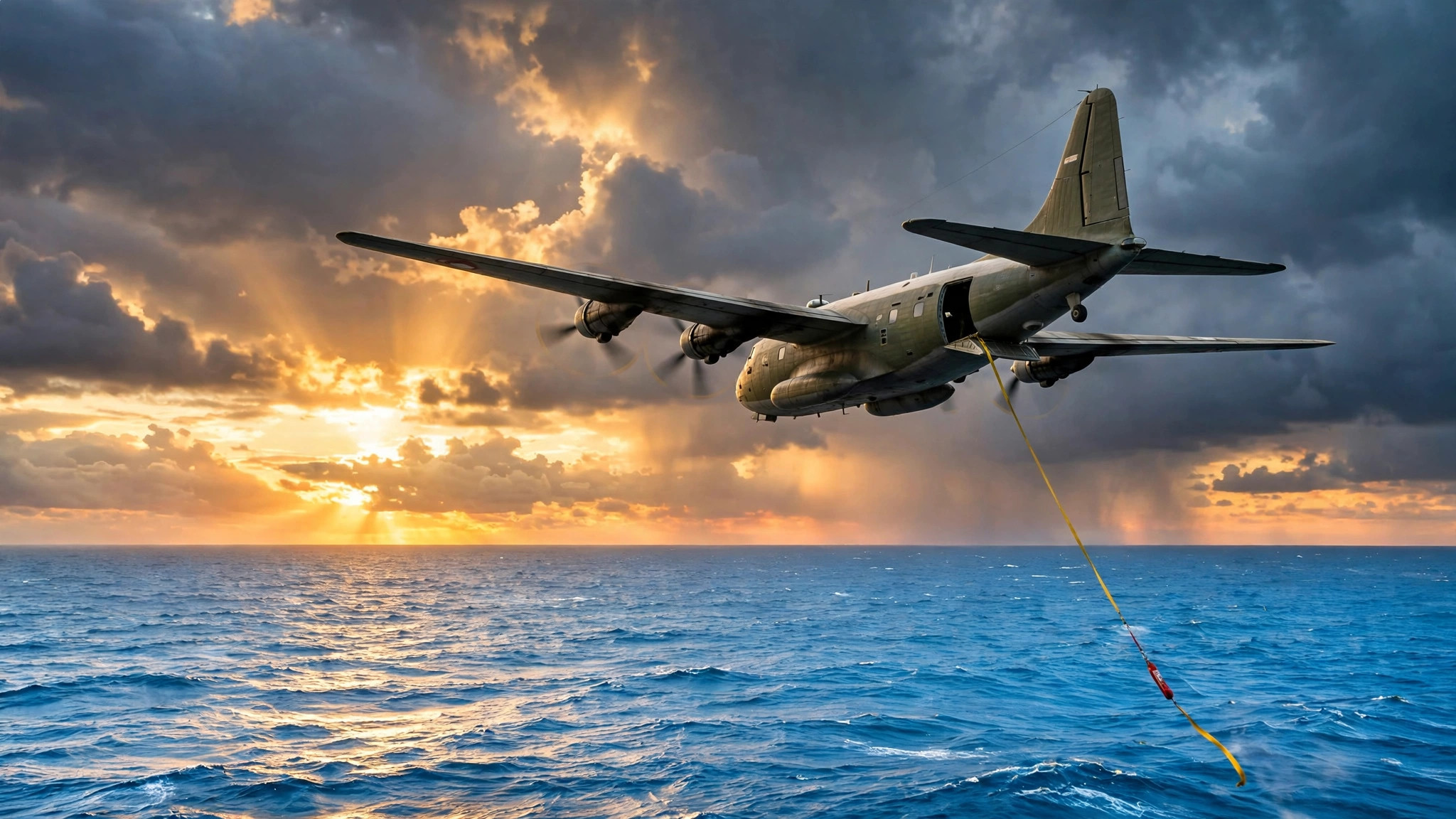
Then the film delivers its final piece of spectacle. A passing aircraft lowers a line, and Bond and Domino are lifted out of the water by the Fulton surface-to-air recovery system — the “skyhook” — a real system the United States military used to pick people up from the ground without landing.
The two of them rise into the sky, still dripping wet, as the credits prepare to roll. It is a strange, triumphant image: the most expensive Bond film ever made ends not with a kiss on a beach, but with its hero and heroine dangling from a rope under an aeroplane. The skyhook is the last image of the thunderball ending explained, and it is the one audiences remember: two people rising out of the sea on a line, saved by a machine nobody in the audience had ever seen.
There is no post-credits scene. Like most Bond films of the era, Thunderball simply ends with the promise that James Bond will return — in You Only Live Twice (1967), where Bond will finally meet Blofeld face to face. Blofeld himself appears in Thunderball only as a voice and a shadow; his face is never shown. The film keeps its biggest villain in reserve.
The Ending, Beat by Beat
Here is the thunderball ending explained as a beat-by-beat timeline, from the sunken bomber to the skyhook:
- The first bomb is found: Bond and Leiter dive on the sunken Avro Vulcan and recover the first atomic bomb. Angelo’s body is inside the wreck — proof of how Largo treats his own people.
- Domino turns: Bond tells Domino that Largo murdered her brother François. She agrees to spy on Largo and boards the Disco Volante with a Geiger counter hidden in a camera.
- Domino is caught: Largo discovers her, tortures her for information, and keeps her prisoner aboard the yacht.
- The underwater battle: Bond leads United States Navy frogmen against Largo’s divers. After a long fight with harpoons and knives, Largo’s men are defeated.
- The second bomb moves: Largo has already loaded the second bomb aboard the Disco Volante, bound for Miami, the city SPECTRE will destroy if the ransom is not paid.
- Bond boards the yacht: Bond gets aboard the Disco Volante and fights Largo, but Largo is bigger and stronger and has him cornered.
- Domino kills Largo: Domino escapes her bonds and shoots Largo in the back with a spear gun, avenging her brother and saving Bond’s life.
- The yacht explodes: Out of control, the Disco Volante crashes into the rocks and explodes. Bond and Domino leap into the sea just in time.
- The skyhook: A passing aircraft picks Bond and Domino out of the water with the Fulton surface-to-air recovery system, lifting them into the sky.
- James Bond will return: The film ends with the traditional promise of the next adventure, and no post-credits scene.
What the Ending Means

The thunderball ending explained is not really about the bombs. It is about who gets to pull the trigger. Largo’s whole plan depends on other people doing his work: Angelo flies the plane, his divers move the bombs, Fiona kills his loose ends, and Domino decorates his yacht. When the plan falls apart, it falls apart because the people he used turn on him — first Domino, then the frogmen, then the Navy.
Largo is the only Bond villain who is killed by his own victim, and the film treats that as justice, not as a twist.
The ending also matters because of what it says about Bond in 1965. This is Connery at the height of his powers, and the film gives him the biggest production the series had ever attempted — a $9 million budget, a worldwide gross of $141.2 million, the most successful Bond film until Live and Let Die (1973), and an Academy Award for Best Visual Effects.
Yet the climax still hands the decisive moment to someone else. Thunderball is the film where Bond learns he cannot do it alone: he needs Leiter’s CIA contacts, the Navy’s frogmen, and Domino’s spear gun. The skyhook at the end is the perfect image for that — Bond literally cannot get out of the water by himself.
There is also a quieter meaning in the Miami reveal. SPECTRE threatens an unnamed city for most of the film, and the audience spends two hours wondering which one it will be. When Bond discovers it is Miami, the threat becomes specific and American — a holiday city full of ordinary people, not a capital full of politicians.
The film never shows Miami being attacked. It does not need to. The whole point of the ending is that the attack never happens.
Film vs Book: What Fleming Wrote Differently
The thunderball ending explained changes when you read Ian Fleming’s 1961 novel, the ninth Bond book. The film keeps the bones of Fleming’s story — the stolen bombs, the £100 million ransom, Largo, Domino, and the underwater hunt — but it rebuilds the ending for the screen. Here is how the two versions compare:
| Film (1965) | Novel (1961) | |
|---|---|---|
| The assassin | Fiona Volpe, a SPECTRE killer who murders Count Lippe with a motorcycle rocket and dies at the Junkanoo | No Fiona Volpe — she is invented for the film |
| Domino’s name | Domino Derval, sister of the murdered pilot François Derval | Domino Vitali, sister of the murdered pilot François Vitali |
| The final battle | A giant underwater battle with United States Navy frogmen, then a fight aboard the Disco Volante | A smaller underwater fight; no Navy battle, no boarding of the yacht |
| Who kills Largo | Domino, with a spear gun aboard the Disco Volante | Domino, with a spear gun — the one beat the film keeps exactly |
| The rescue | Bond and Domino are lifted from the sea by the Fulton skyhook | No skyhook — the rescue is quieter and the ending is smaller |
| Blofeld | Heard only as a voice, face never shown | Blofeld appears in person at the SPECTRE meeting, and his identity is known |
The one thing Fleming and the film agree on is the spear gun. Domino killing Largo is in the novel, and it is the heart of both versions. Everything else — the Navy, the yacht fight, the skyhook — is the film spending its $9 million budget on spectacle. Fleming’s ending is a quiet revenge; the film’s ending is a fireworks display with the same bullet.
Thunderball Ending Timeline
| Date | What happened |
|---|---|
| 1961 | Ian Fleming publishes the novel Thunderball, his ninth Bond book, based on a story he developed with Kevin McClory and Jack Whittingham. |
| 16 February 1965 | Filming begins, with the opening pre-title sequence shot in Paris. |
| 9 December 1965 | Thunderball premieres in Tokyo, the first Bond film to open in Japan first. |
| 22 December 1965 | The film opens in the United States. |
| 29 December 1965 | The film opens in the United Kingdom, and goes on to earn $141.2 million worldwide on a $9 million budget. |
| 1966 | Thunderball wins the Academy Award for Best Visual Effects, for John Stears, and becomes the number-one money maker of the year. |
| 1967 | You Only Live Twice follows, and Bond finally meets Blofeld face to face — the meeting Thunderball deliberately withholds. |
Our Take
Thunderball’s ending is the best argument in the whole series for letting someone other than Bond fire the last shot. The spear gun scene works because the film earns it: Domino is not a last-minute helper, she is a woman who has spent the whole film being used by Largo, and her revenge is the only honest ending the story could have.
Bond stopping the bomb is the mission. Domino killing Largo is the story. That is the thunderball ending explained at its simplest: the mission is Bond’s, but the justice is Domino’s.
The skyhook is silly, and it is supposed to be. After two hours of underwater fighting and a nuclear threat, the film lifts its hero out of the sea like a parcel and dares you to complain.
It is the most 1965 image in the franchise — confident, expensive, and completely unbothered by realism. That is why the thunderball ending explained still gets searched sixty years later: it is the moment the Bond series realised it could be bigger than a spy story, and decided to go to the Bahamas and prove it.
Watch the final ten minutes again and notice what the film does not do. It never shows Miami in danger. It never lets Blofeld appear. It never gives Bond a quip over Largo’s body.
The loudest moment in the film is the yacht exploding, and the quietest is Domino lowering the spear gun. That contrast is the whole ending — and it is why Thunderball, for all its spectacle, is remembered as the Bond film where the girl saved the day.
Frequently Asked Questions
What is the thunderball ending explained in one sentence?
Bond stops SPECTRE from detonating a stolen atomic bomb over Miami, and Domino Derval kills the villain Emilio Largo with a spear gun aboard his yacht the Disco Volante, avenging her murdered brother, before Bond and Domino are rescued from the sea by a skyhook.
Who kills Largo in Thunderball?
Domino Derval kills Largo. As Largo is about to shoot Bond aboard the Disco Volante, Domino — who has escaped from her bonds below deck — shoots him in the back with a spear gun. Largo murdered her brother François, the NATO pilot whose place Angelo Palazzi took to steal the bomber, so her revenge is personal.
What city was SPECTRE going to destroy in Thunderball?
Miami. SPECTRE demands £100 million in diamonds from NATO and threatens to destroy a major city in the United Kingdom or the United States, without naming it. Bond later discovers Largo’s plan is to detonate the second stolen bomb over Miami Beach if the ransom is not paid within seven days.
How are Bond and Domino rescued at the end of Thunderball?
They are lifted out of the sea by a passing aircraft using the Fulton surface-to-air recovery system, known as the skyhook. After the Disco Volante crashes into the rocks and explodes, Bond and Domino jump into the water, and the aircraft picks them up with a line — a real system the United States military used to recover people without landing.
Does Thunderball have a post-credits scene?
No. Like most Bond films of the era, Thunderball has no post-credits scene. The film ends with Bond and Domino being rescued by the skyhook, followed by the traditional promise that James Bond will return — in You Only Live Twice (1967), where Bond finally meets Blofeld face to face.
Read Also:
Read Also:
James Bond Movies: The Complete 007 Film Guide (1962–2026)
Goldfinger Ending Explained: Fort Knox, the 007-Second Bomb and Goldfinger’s Fall
From Russia with Love Ending Explained: Grant, Klebb and the Venice Finale
For the film’s full background, the Wikipedia page on Thunderball covers its production, cast and box-office record in detail, and PlotExplained’s Thunderball summary walks through the full plot, including the ending, scene by scene.
That is the thunderball ending explained, start to finish: two stolen atomic bombs, a £100 million ransom, a murdered pilot’s sister with a spear gun, a yacht on the rocks, and a rescue from the sky.
Watch the final battle again and the thunderball ending explained changes completely — every minute Bond spends underwater is time Largo is spending on his yacht, every second Domino spends in captivity is a reason for the shot she eventually takes, and every frame of the skyhook is the film telling you that this hero, for once, could not save himself. Few Bond endings reward a second viewing as richly as this one, and none of them hands the killing blow to the girl.

Kunal Chaudhary is the founder and editor of Media1Gyan, covering Bond 26 casting news, rankings and Bond history since July 2026, sourcing every developing story from trade reporting and official announcements and labelling rumor separately from confirmed fact. Kunal is the founder and editor of Media1Gyan.com, an independent James Bond 007 fan blog. A lifelong James Bond fan, he started Media1Gyan to give fellow fans clear, well-researched coverage of the world of 007 — from the classic Eon films to the new Amazon-MGM era and the road to Bond 26. On Media1Gyan, Kunal covers Bond movie news and casting rumors, ranked listicles (villains, Bond girls, theme songs, gadgets), explainers on Bond history and trivia, and deep dives into characters like Vesper Lynd and Ernst Stavro Blofeld. Every article is researched from publicly available information and reliable sources, and reviewed for accuracy before publishing. His approach is fan-first: no hype without sourcing, no rumors presented as fact, and complex Bond lore explained in plain language. When he covers developing stories like the next James Bond casting, articles are updated as new information breaks. Follow Media1Gyan.com for daily James Bond coverage — news, rankings, and guides for fans around the world. He writes under his real name.