Short Answer
Quantum of Solace ending explained in one line: Bond stops Dominic Greene’s water monopoly by burning down his desert hotel, leaves Greene stranded in the Atacama with only a can of motor oil, and then finds his real ending in snowy Kazan, Russia, where he spares Yusef Kabira – the Quantum agent who seduced Vesper Lynd – hands him to MI6, and drops Vesper’s necklace in the snow. That is the quantum of solace ending explained in short: the mission ends in fire, but the film ends in forgiveness, and the man who started the story as a blunt instrument of revenge walks away as James Bond again.
It is one of the most misunderstood endings in the whole Bond series, and the confusion is understandable. Quantum of Solace (2008) is the only true direct sequel in the franchise: it picks up literally minutes after Casino Royale ends, runs for just 106 minutes, and finishes not with a grand set piece but with a quiet scene in the snow. This article is the full quantum of solace ending explained, beat by beat: what Greene’s plan really was, why Bond leaves him alive in the desert, who Yusef Kabira is, what the necklace means, and why the title itself is the key to the whole film.
The Story So Far: What You Need Before the Final Act
The quantum of solace ending explained properly starts with what Bond already knows by the final act. Quantum of Solace is the 22nd Eon Bond film, directed by Marc Forster and written by Neal Purvis, Robert Wade and Paul Haggis. It stars Daniel Craig in his second appearance as James Bond, and it premiered in London on 29 October 2008 before reaching the UK on 31 October and the United States on 14 November 2008. It grossed $589.6 million worldwide on a budget of $200–230 million, making it the seventh highest-grossing film of 2008.
Bond is hunting the organisation that killed Vesper Lynd. In Casino Royale, Vesper betrayed him — or so he believed — and drowned in Venice. In Quantum of Solace, Bond learns the truth: Vesper was blackmailed by a Quantum agent named Yusef Kabira, who seduced her and threatened her boyfriend to force her to steal from the Treasury. She was a victim, not a traitor. That discovery drives everything Bond does in the final act.
The villain of the film is Dominic Greene, played by Mathieu Amalric. Greene is an environmentalist entrepreneur who fronts the shadowy Quantum organisation. His plan is not to steal gold or launch a missile. It is to help exiled Bolivian General Medrano retake power in exchange for a stretch of apparently worthless desert — land that secretly sits above Bolivia’s fresh water supply. Quantum will dam the water and sell it back to the country at monopoly prices. It is a coup disguised as a property deal, and it is the most quietly realistic villain scheme in the Craig era.
Alongside Bond is Camille Montes, played by Olga Kurylenko. Medrano murdered her family, and she wants revenge — not justice, not money, revenge. Her mission runs parallel to Bond’s, and the film’s ending gives them both the same choice: kill, or let go.
Quantum of Solace Ending Explained: The Desert Showdown

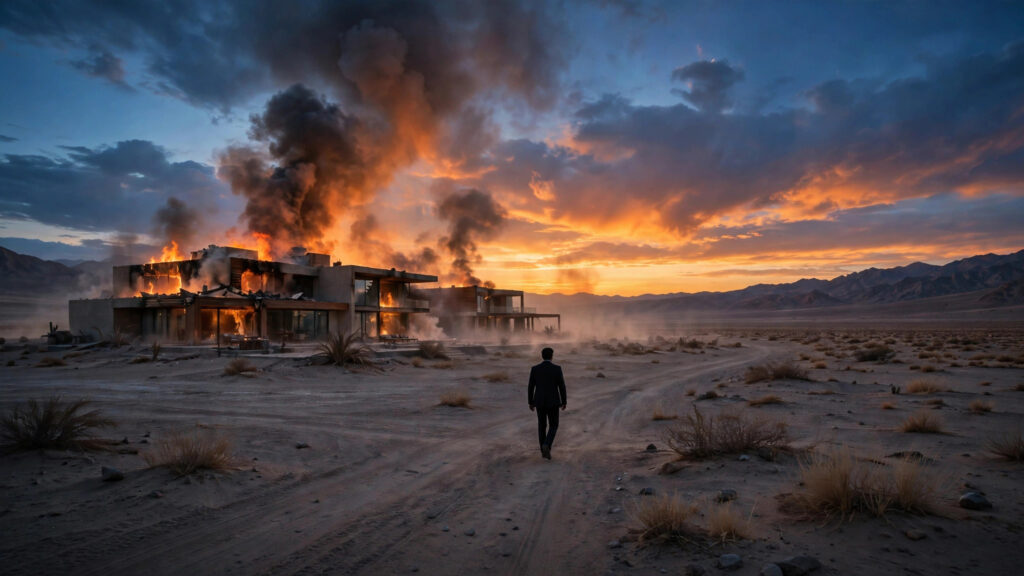
In the quantum of solace ending explained, the desert is where the mission ends. Bond and Camille track Greene and Medrano to a remote eco-hotel in the Atacama Desert in Bolivia, a building powered by hydrogen fuel cells — which, as Bond knows, are effectively a bomb waiting for a spark. Inside, Greene forces Medrano to sign the contract that hands Quantum control of Bolivia’s water. Medrano realises too late that he has signed away his own country, but Greene holds a gun to the deal and Medrano signs.
Then the hotel becomes a war zone. Camille finds Medrano and kills him, avenging her family in a brutal, personal fight. Bond confronts Greene, and the two men brawl through the burning building as the hydrogen cells ignite and the hotel tears itself apart around them. There is no elegant duel, no countdown clock, no villain monologue. It is a fist fight in a fire, and it is deliberately ugly — because this is not the film’s real climax. The real climax is still to come, in the snow.
Bond drags Greene out of the burning hotel alive. He interrogates him about Quantum — its members, its reach, its plans — and Greene talks, because Greene is a coward when the money and the muscle are gone. Then Bond does something no Bond has done before with a main villain: he does not kill him. He drives Greene deep into the middle of the desert, gives him a single can of motor oil, and leaves him there.
What Happens to Dominic Greene?
Leaving Greene in the desert is the film’s cruellest punishment, and it is chosen with care. Greene tried to sell a country its own water. Bond leaves him with oil — the one liquid he cannot drink. It is poetic justice, and Bond knows it: the man who hoarded water dies of thirst surrounded by nothing.
But Greene does not die of thirst. Later, M briefs Bond that Greene’s body was found in the desert with two bullets in his head and motor oil in his stomach. Quantum found him first and executed him for his failure.
That is the quantum of solace ending explained for Greene: the organisation he served cleaned up its own mess. Quantum does not rescue its failures; it silences them. The detail matters, because it tells us what Quantum is — not a gang with loyalty, but a network that treats people as disposable. It also tells us that Bond’s mercy changed nothing for Greene, which is exactly the point: Bond spared him for Bond’s own reasons, not for Greene’s sake.
The Real Ending: Kazan, Yusef Kabira and Vesper’s Necklace
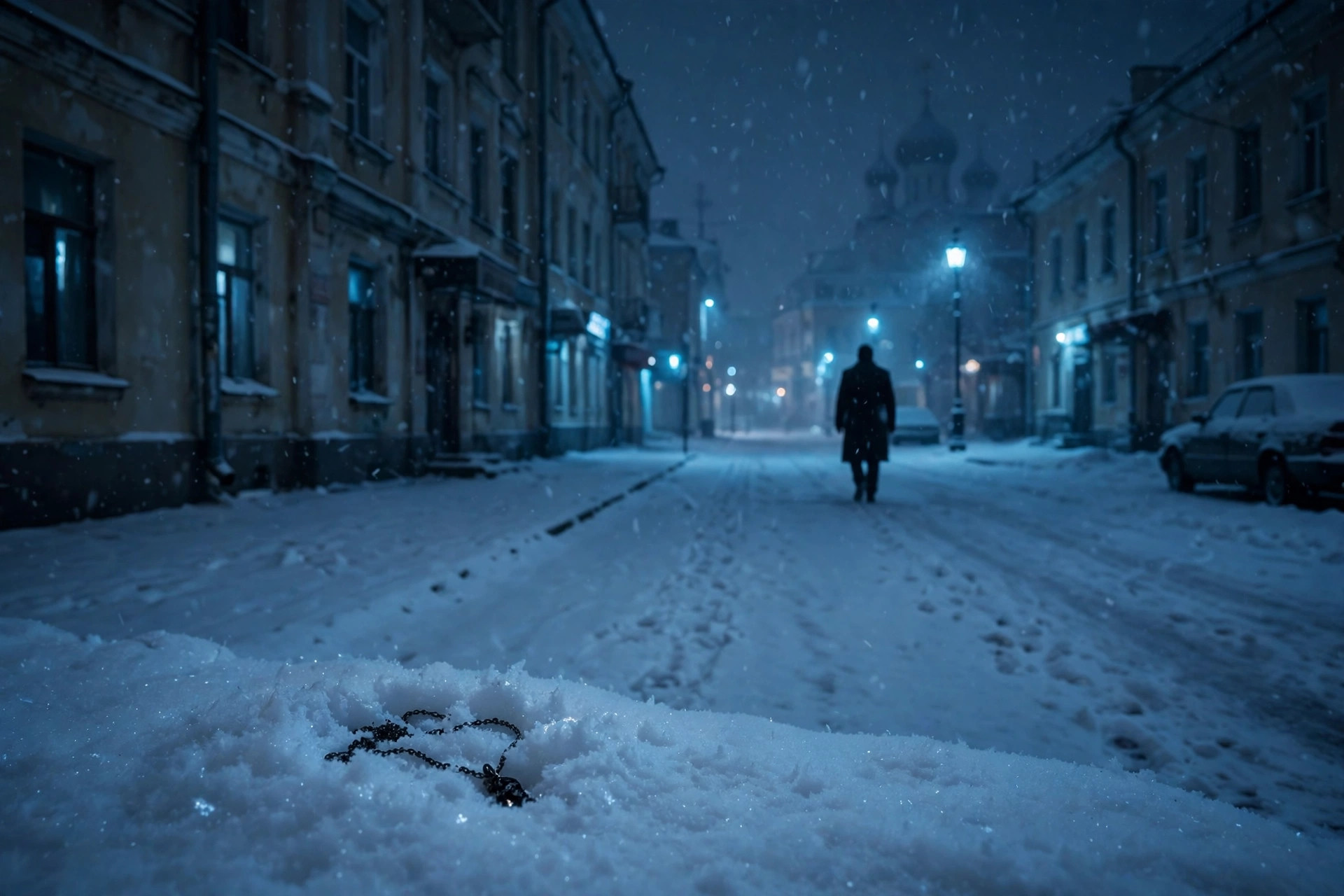
This is the moment the quantum of solace ending explained is really about. Using the information he got from Greene, Bond travels to Kazan, Russia, in the snow. There he finds Yusef Kabira, played by Simon Kassianides — the Quantum agent who seduced Vesper Lynd, staged a fake kidnapping of her boyfriend, and blackmailed her into betraying Bond. Yusef is running the same operation again, this time on Corrine Veneau, a Canadian intelligence agent. He seduces women with valuable connections, fakes a kidnapping of someone they love, and uses the leverage to turn them into thieves and spies.
Bond warns Corrine who Yusef really is, sparing her Vesper’s fate. Then he confronts Yusef — and in the most important decision of the film, he does not kill him. He hands him over to MI6, alive, to face justice. M, watching from London, asks the obvious question: “I assume you killed him.” Bond answers: “No. But I’ll bet he made you sweat.”
Then Bond does the thing the whole film has been building towards. He takes out Vesper’s necklace — the Algerian love knot he gave her in Casino Royale — and drops it in the snow. He walks away, and the camera does not follow him with a quip or a car chase. It lets him go. The necklace in the snow is the film’s final image of Bond’s grief: he has forgiven Vesper, forgiven himself, and put her down at last.
What “Quantum of Solace” Actually Means
The title is the key to the quantum of solace ending explained, and it comes from Ian Fleming himself. “Quantum of Solace” is a short story Fleming published in Cosmopolitan in 1959 and collected in For Your Eyes Only in 1960. The film does not adapt the story’s plot — in Fleming’s tale, Bond sits through a dinner party in Nassau while a colonial governor tells him a tragic story about a marriage. But it takes the story’s central idea.
As the governor explains it, the “quantum of solace” is the smallest measurable amount of comfort, compassion and humanity that keeps a relationship alive. When that quantum drops to zero, humanity and consideration for one another are gone, and the relationship is finished. In the film, Bond spends two hours with his quantum of solace at zero: he trusts no one, forgives no one, and kills without hesitation. The ending is the moment it comes back. By sparing Yusef, saving Corrine, and letting Vesper go, Bond recovers the smallest measure of humanity that makes him a person again — and, not coincidentally, makes him James Bond again.
The Ending, Beat by Beat
Here is the quantum of solace ending explained as a beat-by-beat timeline, from the desert to the snow:
- The desert hotel: Bond and Camille infiltrate Greene’s eco-hotel in the Atacama Desert. Camille kills Medrano, avenging her family. Bond fights Greene as the hydrogen fuel cells ignite and the hotel burns.
- Greene’s interrogation: Bond drags Greene out alive and questions him about Quantum. Greene talks, giving Bond the lead to Yusef Kabira in Kazan.
- The motor oil: Bond abandons Greene in the middle of the desert with only a can of motor oil — a punishment for a man who tried to steal a country’s water.
- Greene’s death: M later tells Bond that Greene was found dead with two bullets in his head and oil in his stomach. Quantum executed him for failing.
- Mathis’s lesson: Before all of this, the dying René Mathis tells Bond to forgive Vesper and forgive himself. Bond carries that advice into the final scene.
- Kazan: Bond finds Yusef Kabira in snowy Kazan, Russia, running the same honeytrap on a Canadian agent, Corrine Veneau. Bond warns her and confronts Yusef.
- The choice: Bond hands Yusef to MI6 alive instead of killing him — the first merciful choice he has made in two films.
- The necklace: Bond drops Vesper’s necklace in the snow and walks away. The vendetta is over. Bond is back on duty.
Why Bond Spares Yusef — And Why It Matters

Why does Bond spare Yusef? The quantum of solace ending explained hinges on this question, because killing Yusef would have been easier, safer and more satisfying. Yusef destroyed Vesper’s life and, through her, Bond’s. A bullet would have closed the circle in seconds. Bond chooses the harder path for three reasons, and each one is the film’s thesis.
First, killing Yusef would have been revenge, not justice, and Bond has spent the whole film learning that revenge does not heal anything. Camille gets her revenge on Medrano and walks out of the burning hotel empty — her family is still dead, and the film does not pretend otherwise. Bond watches that and understands it.
Second, Yusef alive is useful. Handed to MI6, he can be interrogated, and his network can be rolled up. Bond the professional finally outweighs Bond the grieving lover. It is the moment the 00 agent returns.
Third, and most important, sparing Yusef is how Bond forgives Vesper. Vesper was Yusef’s victim, just as Corrine nearly was. By saving Corrine and sparing Yusef, Bond does for Vesper — after the fact — what he could not do while she was alive: he protects the woman she was, instead of avenging the woman he thought she was. Dropping the necklace in the snow is the punctuation mark. The grief is not gone, but it no longer owns him.
How the Ending Sets Up Skyfall
The quantum of solace ending explained also resets the series. When Quantum of Solace ends, Bond is no longer the raw, vengeful rookie of Casino Royale or the rage-driven hunter of this film. He is a professional again: controlled, merciful when it counts, and back in M’s good graces. Skyfall (2012) picks up that thread — a Bond who has made peace with his past and can face a villain, Silva, who is essentially what Bond would have become if he had never let Vesper go.
The film also plants seeds that pay off years later. Quantum, the organisation Bond has been chasing, is revealed in Spectre (2015) to be a subsidiary of the larger SPECTRE network, and Mr. White — the Quantum agent Bond captured in the opening car chase — returns in that film. So while Quantum of Solace closes Bond’s personal story, it leaves the organisation’s story open, and the Craig era keeps pulling on that thread until No Time to Die (2021).
| Casino Royale (2006) | Quantum of Solace (2008) | |
|---|---|---|
| Bond’s state | Newly promoted 00, falls in love, loses Vesper | Consumed by revenge, finds closure, returns to duty |
| Villain’s fate | Le Chiffre is shot dead by Mr. White | Greene is left in the desert, then executed by Quantum |
| Vesper | Betrays Bond, then drowns in Venice | Revealed as Yusef’s blackmailed victim; Bond forgives her |
| Final image | Bond introduces himself: “Bond. James Bond.” | Bond drops Vesper’s necklace in the snow and walks away |
| What changes | Bond becomes 007 and loses his heart | Bond regains his humanity and his purpose |
Our Take
Our take on the quantum of solace ending explained: it is the bravest ending in the Craig era, and the most underrated. Most Bond films end with an explosion and a quip. This one ends with a man choosing not to pull a trigger, and that choice is harder to film than any car chase. The desert showdown is deliberately unsatisfying — Greene is not killed on screen, the hotel burns without ceremony — because the film is telling us that the action was never the point. The point was always the snow in Kazan.
That said, the ending only works if you watch Casino Royale first. On its own, Quantum of Solace is a chase film with a confusing plot and a villain whose scheme — water rights in Bolivia — sounds like a UN briefing.
Seen as the second half of a two-part story, it is something rarer: a Bond film about grief, and about the exact moment grief stops running the man. The necklace in the snow is the best final shot of any Bond film since Tracy’s death in On Her Majesty’s Secret Service, and it earns its silence. If you have only seen this film once, watch the last ten minutes again with the title’s meaning in mind — the whole movie rearranges itself around them.
Frequently Asked Questions
What is the quantum of solace ending explained in one sentence?
Bond burns down Dominic Greene’s desert hotel, leaves Greene stranded with a can of motor oil, then travels to Kazan, spares the Quantum agent Yusef Kabira who blackmailed Vesper, and drops Vesper’s necklace in the snow — ending his vendetta and returning to duty as 007.
Does Bond kill Dominic Greene at the end of Quantum of Solace?
No. Bond leaves Greene alive in the Atacama Desert with only a can of motor oil to drink. Greene is later found dead with two bullets in his head and oil in his stomach — Quantum executed him for his failure, as M reports to Bond.
Who is Yusef Kabira and why does Bond spare him?
Yusef Kabira is a Quantum agent who seduced Vesper Lynd and blackmailed her into stealing from the Treasury by threatening her boyfriend. Bond spares him because killing him would be revenge, not justice; a living Yusef can be interrogated by MI6; and sparing him is how Bond forgives Vesper and lets go of his grief.
Does the quantum of solace ending explained include a post-credits scene?
No. Like most Bond films, Quantum of Solace has no post-credits scene. The film ends with Bond dropping Vesper’s necklace in the snow and walking away, followed by the traditional “James Bond Will Return” title card.
What does “quantum of solace” mean?
It comes from Ian Fleming’s 1959 short story of the same name. The “quantum of solace” is the smallest amount of comfort and humanity in a relationship; when it drops to zero, the relationship is over. In the film, Bond’s quantum returns when he chooses mercy over revenge in the final scene.
Read Also:
Read Also:
James Bond Movies: The Complete 007 Film Guide (1962–2026)
Skyfall Ending Explained: M’s Death, Silva’s Revenge and the Reset
Spectre Ending Explained: Blofeld, Nine Eyes and Bond’s Choice
For the film’s full background, the Wikipedia page on Quantum of Solace covers its production, box office and legacy in detail, and ScreenRant’s explanation of the title’s meaning traces the phrase back to Ian Fleming’s short story.
That is the quantum of solace ending explained, start to finish: a water monopoly stopped in a burning desert hotel, a villain left with a can of motor oil, and a hero who finds his ending not in a gunfight but in a snowy street in Kazan. Watch it again and the quantum of solace ending explained changes completely — every furious chase in the first hour is a man running from grief, and the quiet final scene is the moment he finally stops running. Few Bond endings reward a second viewing as richly as this one.

Kunal Chaudhary is the founder and editor of Media1Gyan, covering Bond 26 casting news, rankings and Bond history since July 2026, sourcing every developing story from trade reporting and official announcements and labelling rumor separately from confirmed fact. Kunal is the founder and editor of Media1Gyan.com, an independent James Bond 007 fan blog. A lifelong James Bond fan, he started Media1Gyan to give fellow fans clear, well-researched coverage of the world of 007 — from the classic Eon films to the new Amazon-MGM era and the road to Bond 26. On Media1Gyan, Kunal covers Bond movie news and casting rumors, ranked listicles (villains, Bond girls, theme songs, gadgets), explainers on Bond history and trivia, and deep dives into characters like Vesper Lynd and Ernst Stavro Blofeld. Every article is researched from publicly available information and reliable sources, and reviewed for accuracy before publishing. His approach is fan-first: no hype without sourcing, no rumors presented as fact, and complex Bond lore explained in plain language. When he covers developing stories like the next James Bond casting, articles are updated as new information breaks. Follow Media1Gyan.com for daily James Bond coverage — news, rankings, and guides for fans around the world. He writes under his real name.